“Shame loves secrecy. Shame derives its power from being unspeakable. When something shameful happens to us and we keep it locked up, it festers and grows. It eats us alive from the inside.” Brené Brown
For as long as I can remember, I’ve carried a heavy, exhausting feeling: I am in trouble. It didn’t matter how successful I became, how hard I worked, or how diligently I managed my life, the voice in the back of my mind always whispered that a penalty was coming, that I was inherently bad and in time, everyone would discover it. I believed I had to prove my utility and worth just to be allowed in the room.
I used to think this anxiety was just a personal flaw I needed to fix with willpower and logic. After years of writing, I finally see the common denominator. That constant dread wasn’t a glitch in my adult life; it was the exact lesson I was taught by the people who were supposed to love and protect me when I was a child.
When I was between four and six years old, my brother, nine years older than I, repeatedly violated my body. He would get into my bed after lights-out and tell me he was just curious and wanted to explore, because my private body parts weren’t like his. One afternoon, he was finally caught at my Grandmother’s house in the cellar, as he was laying next to me with his hands between my thighs, once again touching the parts of me no one should have been. At that exact moment, the adults in my family owed me total protection, fierce comfort, and justice. Instead, I was yanked up off the floor from next to my brother, and sent off alone without a single word further about it. After a confusing under-reaction from these adults who normally overreacted to everything, my parents’ ultimate choice was to preserve my family’s fragile internal order and pretend nothing had happened.
That rule of silence followed me out of the dark and into the light of parent-sanctioned compliance. Around my age six, my mother allowed her twin sister’s husband to photograph me nude on multiple occasions. One of the photo-shoots was with my similar age girl cousin, his daughter. My uncle took pictures of my naked cousin and me in various poses together against a white, studio backdrop, and we were told this was all for an exhibit somewhere in Eastern Europe. It was the late 1970s and he considered himself a talented photographer. In one particular photo my cousin wasn’t made to do, my mother allowed my uncle to have me lay down outside in grass right by train tracks, and open my legs wide toward the passenger train that was coming by for a very specific kind of action shot capturing the train and its passengers’ reaction to the angle of my child’s vulnerable body they were presented. This particular photo survived well into my adulthood and I could recognize my naked body on it.
When my brother wasn’t punished for molesting me and I was casually shown the naked photo exhibit images of me the world would see as if I was a third-party, adult bystander in a swimsuit on a beach, these parent-complicit events sent a terrifying message to my system: Your body does not belong to you. Anyone with authority can breach your boundaries at any time. My underlying feelings were not only rejected, but my desperate words that expressed them were flipped on me. Over time, these events morphed into a focus not on what happened to me, but on how I dealt with them.
When I was eleven and my mother was already living a continent away, the rules of silence simply took on a new face. I often played everyday, innocent neighborhood games with boys and girls my age. In a highly urban childhood, the playground is for all children. My stepmother, a very religiously conservative person, took that harmless childhood play and twisted it, insinuating I was engaging in inappropriate activities. She had clearly taken the position I was a damaged little girl without a moral compass. More shaming. This time, from a person who was a medical professional. A few months later, discovering that I had sometimes fallen asleep next to my father watching television in bed when she wasn’t there, she decided to treat my eleven-year-old body like a crime scene. She marched me to a doctor colleague of hers for an excruciatingly painful gynecological exam just to verify my virginity. That forced exam wasn’t medical care. It was an interrogation of a little girl’s body to satisfy an adult’s paranoia. When my brother was molesting me, I was the only one who bore the consequences. When my father wasn’t, I was once again the one who was put through hell.
When a child is small and the adults demand that she pretend a crime never happened, or worse, when they actively permit her boundaries to be breached, the young mind makes a terrible deal with itself: Speaking the truth is dangerous. The world is unsafe. I am the one in trouble.

In my teen and later years, my mother didn’t want to hear about my stories from the years I was in Hungary but she wasn’t. My mother, fueled by her newfound engagement in American church, insisted I put all of these things behind me like she had, denying my reality and condemning me for insisting upon fighting for it. I would often not back away from these conversations immediately, drawing some details out of her, which only made me more exasperated. She wouldn’t deny these things occurred, she would only focus on how it really wasn’t her fault. She would say she didn’t understand why my father didn’t punish my brother or that she didn’t know the exact pose my uncle was putting me in. My fight for my sanity and my need to have my mother own the things of which she was fully aware and acknowledge the things that happened because she wasn’t around are the reasons I earned her lifelong discrediting campaign against me.
And I’m here, to remind you
Of the mess you left when you went away
It’s not fair, to deny me
Of the cross I bear that you gave to me
You, you, you oughta knowYou seem very well, things look peaceful
I’m not quite as well, I thought you should knowAlanis Morissette
To survive a childhood environment that felt like a minefield, I had to build a massive psychological shield. I became hyper-vigilant. I learned to read every room, analyze every facial expression, and fiercely guard my perimeter. My Imago Octopus was born. I came to believe that if I could produce evidence and data, I could save myself.
This survival mechanism also shaped my marriages. I subconsciously chose partners who at first appeared strong, protective, and solid; people I hoped could finally hold the shield for me so I could rest. …but once the marriages began, the everyday realities cracked the facades. My spouses became passive and fragile, pulling away and shutting down whenever things got difficult. Just like my family, my spouses demanded we pretend conflicts didn’t exist and forced a reset back to a happy face without ever fixing the hurt. This demand for a compliant reset is like a video game respawn, an artificial button that drops a person back at the baseline with a clean slate, pretending the crash never occurred. …but relationships are not digital simulations. When you respawn instead of engaging in raw, agonizing repair, the old damage doesn’t disappear; it just gets buried under the floorboards of the new facade. I repeatedly married the exact environment that wounded me in the first place. This was not by accident; this psychological inevitability is what Imago Relationship Therapy is all about. In flawlessly executing my childhood programming, I dutifully stayed quiet about how my marriages were really doing, isolating myself in my loneliness and shame, and setting myself up for each subsequent narrative exploitation.
When I finally started examining my own patterns and relating those back to my childhood, my mind put up a massive fight. I could remember the cold facts of what my brother and stepmother did, I even wrote on this very website about them, but my brain clinically rejected the actual words: violated, unprotected, abandoned. My mind recycled frantic internal arguments, debating definitions, and trying to convince me that it wasn’t really that bad. My brain did this with my marriages, too. Minimization always feels safer than raw grief. My mind was terrified that if I admitted how deeply I had been hurt, the pain would swallow me whole.
The rules of silence aren’t just policed inside our own heads; they are enforced by a family syndicate. When the matrix is threatened by raw data, the enforcers recruit a club, enlisting siblings, friends, former spouses, and in my case, even grooming my own preteen children to build a collective narrative that the truth-teller is the dangerous one. It is a brilliant, self-preserving strategy designed to absolve the original perpetrators of their negligence and keep the system locked down.
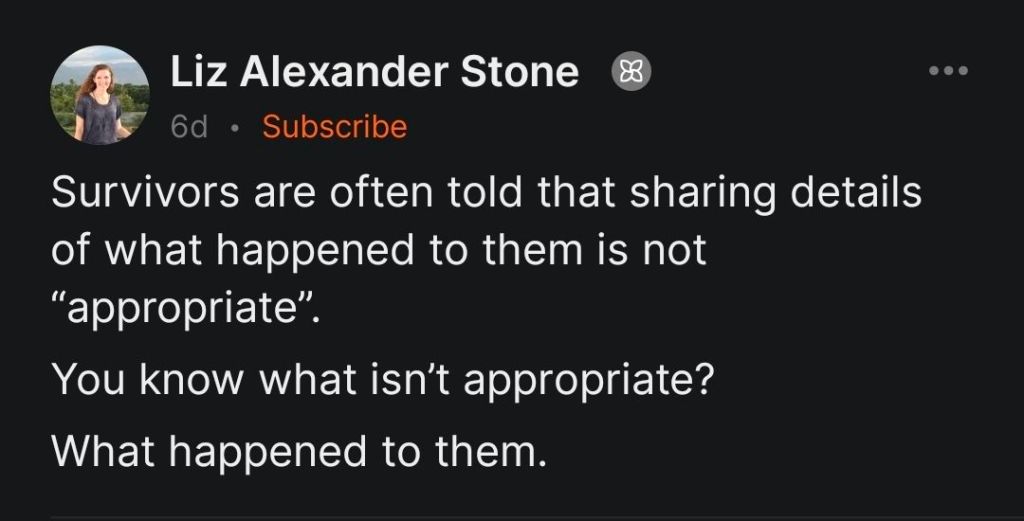
My internal debate is finally over. The anger I feel when my mind (or anyone else) tries to minimize my past isn’t a symptom of being broken, it is my adult strength waking up. It is me standing at the door of my history and saying, “I know the facts. No one gets to change the data to make the ghosts comfortable anymore.”
I am finally ready to shine my light, and to consciously coexist with the whole of my experiences. I now live in my own space where the boundaries are absolute and entirely mine. The people who failed to protect me, weaponized first my innocence then my good will, and demanded my silence have no place here. The hyper-vigilant protector…the Octopus I had to become to survive my childhood doesn’t need to be destroyed; she just needs a permanent retirement. She did a brilliant job keeping me alive, but I don’t need to fight a war that ended decades ago. That little girl was left completely unprotected, but the woman running my life today has absolute sovereignty. The silence is broken. The truth sticks. Not on their watch, but on mine. …and this is the upstream. This is where I needed to go so I could have a chance at reaching, validating and nurturing my eight-year-old self pacing alone in agony on the sidewalk outside my mother’s building.



Leave a Reply