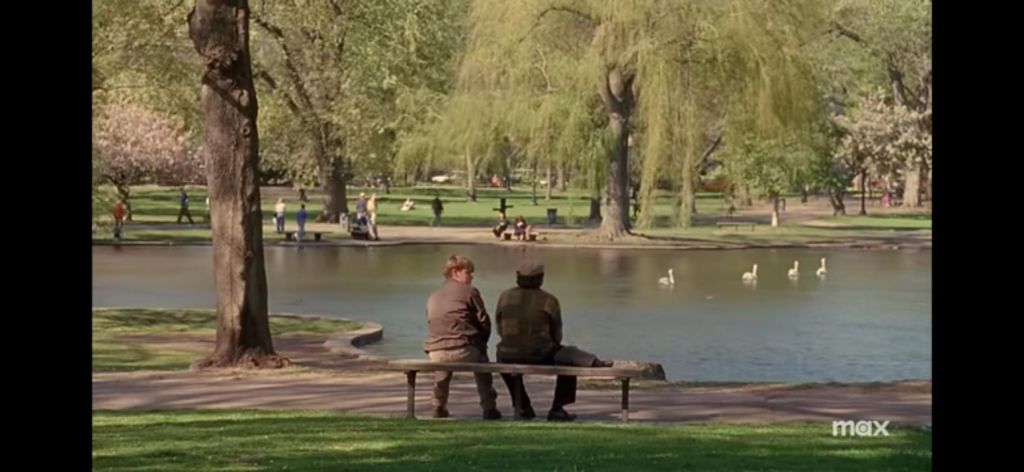
“…something occurred to me. I fell into a deep peaceful sleep and I haven’t thought about you since. You know what occurred to me?”
“No.”
“You’re just a kid. You don’t have the faintest idea of what you’re talking about.”
“Why, thank you.”
“It’s all right. You’ve never been out of Boston.”
“Nope.”
“So if I asked you about art, you’d probably give me the skinny on every art book ever written. Michelangelo. You know a lot about him. Life’s work, political aspirations, him and the Pope, sexual orientation, the whole works, right? …but I bet you can’t tell me what it smells like in the Sistine Chapel. You’ve never actually stood there and looked up at that beautiful ceiling.
If I ask you about women, probably give me a syllabus of your personal favorites. You may have even been laid a few times. But you can’t tell me what it feels like to wake up next to a woman and feel truly happy.
You’re a tough kid. I ask you about war, you’d probably throw Shakespeare at me, right, once more into the breach, dear friends. …but you’ve never been near one. You’ve never held your best friend’s head in your lap and watch him gasp his last breath looking to you for help.
I ask you about love, probably quote me a sonnet. But you’ve never looked at a woman and been totally vulnerable. Known someone who could level you with her eyes. Feeling like God put an angel on Earth just for you, who could rescue you from the depths of hell. And you wouldn’t know what it’s like to be her angel, to have that love for her be there forever, through anything, through cancer. …and you wouldn’t know about sleeping sitting up in a hospital room for two months holding her hand, because the doctors could see in your eyes that the terms visiting hours don’t apply to you.
You don’t know about real loss, because that only occurs when you love something more than you love yourself. I doubt you’ve ever dared to love anybody that much.
I look at you; I don’t see an intelligent, confident man. I see a cocky, scared shitless kid. …but you’re a genius, Will, no one denies that. No one could possibly understand the depths of you. But you presume to know everything about me because you saw a painting of mine, you ripped my fucking life apart.
You’re an orphan, right? Do you think I’d know the first thing about how hard your life has been, how you feel, who you are, because I read Oliver Twist? Does that encapsulate you?
Personally, I don’t give a shit about all that, because you know what? I can’t learn anything from you I can’t read in some fucking book! …unless you want to talk about you. Who you are. …and I’m fascinated, I’m in. But you don’t want to do that, do you, Sport? You’re terrified of what you might say.
Your move, Chief.”
Today, calling a traumatized patient a “cocky, scared shitless kid” and directly challenging his intellectual defenses would be skewered in social-media feeds as abrasive, abusive, and triggering. Sean would be labeled toxic. Yet that reaction illustrates precisely why internet pop psychology collapses when applied to real human depth; it pathologizes emotional friction and mistakes necessary confrontation for harm.
Will is an intellectual prodigy who weaponizes clinical detachment. He has already run through five conventional, textbook therapists by mocking their credentials, exposing their insecurities, and manipulating the artificial hierarchy of a traditional therapist-patient dynamic. Will’s defense mechanism is hyper-intellectualization, using books, art history, and philosophy as an impenetrable fortress to ensure nobody ever gets close enough to touch the underlying abandonment and physical abuse he endured in his formative years.
A therapist offering sanitized platitudes, reflexive validation, or sterile holding space would simply become Will’s next casualty.
Sean succeeds because he rejects the role of a sterile technician. He realizes that Will cannot be healed by academic debate; he can only be reached through an existential encounter. By meeting Will outside the clinic, admitting his own grief, and refusing to let Will hide behind literature, Sean strips away the armor. He confronts Will with a reality Will cannot read his way out of: the gap between knowing about life and actually living it. For humans, nothing substitutes the experience of feeling something on our own skin.
Where modern pop-culture psychology prizes frictionless, risk-averse comfort, often teaching people to cut off anyone who challenges them under the guise of protecting my peace, Sean demonstrates that genuine transformation requires staying in the room through the mess, the anger, and the blunt truth.
“It’s not your fault.“
When Sean first utters those four words, Will’s reaction is predictably cerebral: “Yeah, I know that.” He offers the quick, dismissive nod of a scholar confirming an uncontested fact on an exam.
In Will’s framework, trauma has been cataloged and categorized like everything else in his formidable brain. He understands the clinical mechanics of child abuse; he can recite the sociology of abandonment and rationalize his foster care scars into a neat, detached intellectual file. He knows the premise. He accepts the theory.
Yet Sean doesn’t let him hide behind the intellectualization. Sean steps out from behind his desk. He closes the physical distance. He says it again.
“It’s not your fault.”
The power of the scene lies in Sean’s refusal to treat Will’s trauma as an academic problem to be solved. Modern therapy culture often fixates on narrative analysis and sanitized cognitive reframing, talking endlessly about pain from a safe, clinical elevation. Think looking at a route from Point A to your destination on Google Maps. (I know this well. I’m fantastic at it.)
…but hyper-intellectualized trauma cannot be reasoned away because reason was forged as the armor in the first place. For someone who survived terror by abandoning their body and retreating entirely into their mind, intellectual agreement is just another fortress wall. It is a polite, impenetrable way of saying, “Do not come any closer.“
With each repetition, Sean is not imparting new information; he is systematically dismantling Will’s distance. He forces Will out of Will’s external, carefully curated view of himself, and directly into the visceral reality of Will’s own wounded self.
Will’s escalating reaction charts the exact anatomy of a dying defense mechanism. First comes casual deflection (“I know“), followed quickly by irritation, and then by open hostility: “Don’t fuck with me, Sean.” The shove that follows is the last desperate perimeter fence. If Will can provoke Sean into retaliating, into shouting, or into retreating into cold professional boundaries, the defense holds. The script remains intact. Will can remain the cynical prodigy who was right all along about the fragility of human connection.
Instead, Sean absorbs the aggression without flinching. He doesn’t pathologize the anger, and he doesn’t run away to protect his peace. He stays planted in the line of fire. He repeats the words with unyielding, tender stubbornness until the sheer weight of unconditional presence shatters the armor completely.
When Will finally collapses into tears, burying his head into Sean’s shoulder, the breakthrough is visceral, not intellectual, not analytical. He isn’t weeping because he learned a new truth; he is weeping because he was finally forced to feel the truth he had spent a lifetime keeping at arm’s length. He dropped into his own street view on Google Maps. The phantom burden of guilt, the irrational conviction carried by every abandoned and/or abused child that they somehow deserved the adults’ behavior, finally loses its grip.
Real transformation rarely happens through polite consensus or frictionless validation. It happens when someone cares enough to see through the sharpest defenses a wounded mind can construct, stays in the room through the fury and panic, and refuses to leave until the person underneath finally surrenders to being seen.


Leave a Reply