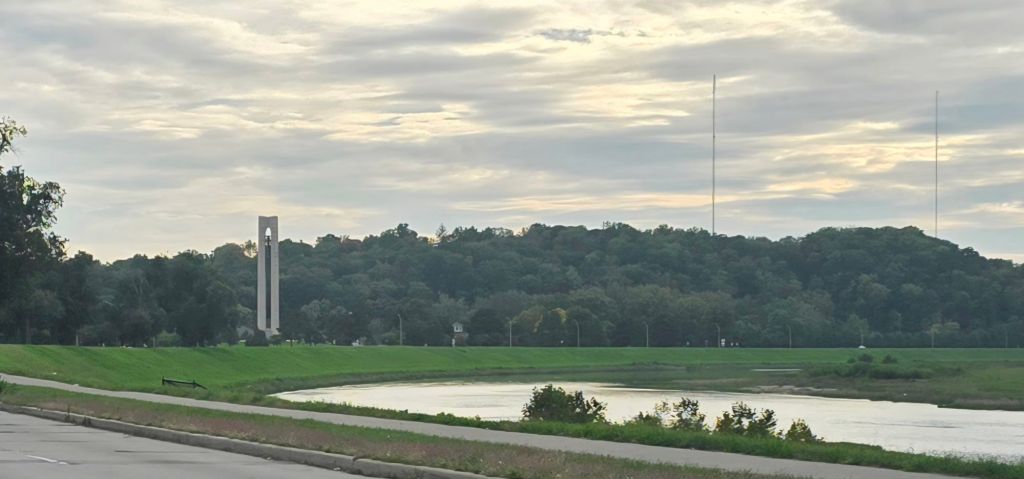
I have gotten a few days of merciful distractions with work out of town, but tonight, I took a walk along a Midwestern city’s river walkway. This isn’t one of those crowded commercial fabrications, but a serene, duck-inhabited, green one. I was still replaying the events of the workday when sobbing came to the forefront and I was now in the hopelessly alone mind of my young self again, feeling desperate to be with my Mother. It was the most bewildering switch because I hadn’t set an intention, wasn’t thinking about any of it, but walking on the continuous narrow concrete sidewalk up the urban river still transported me there.
Not only was I getting immersed into my full emotions as a child missing my Mother, I could feel that this wasn’t something new or external, but rather a cellar door opening up to remind the homeowner there is another level in the ground, below the facade of their house. It was very familiar and overwhelming; I felt like I was walking through molasses while waves of emotions erupted over and over. I was grateful only the occasional bicyclist rode by me chasing the sunset, and the dimming daylight was hiding my tears.
I don’t know how to win her over. I know she doesn’t like me. I annoy her. If I’m smart and resourceful (talpraesett) like my Father expects me to be, she seems less engaged, not more. He is easier to keep in a happy mood because if I can produce the German translation, solve the random mental puzzle he throws out or notice something obscure on the horizon, he is delighted for a moment or two. My speed, word choices and general hop-to-itiveness are all key to my success with my Father. My Mother on the other hand, seems reflexively perturbed I so readily take to what my Father teaches me. She seems to interpret my willingness to participate successfully in my Father’s quizzing ways as somehow disloyal to her. I feel her pull away during those moments, and for long after. By age six, it is painfully obvious I cannot satisfy him and her at the same time.
The older and more capable I get (a must to stay in the good graces of my Father), the further she feels from me. I don’t know how to get her to want to be with me. There are so many unspoken, unresolved things between us. I have to be very careful not to push her away further. I ask to get to go with her to places all the time. I’m happy to just get to ride in the car with her, even if where we go she will be paying attention to other people. While we are riding there and back, it’s just the two of us. I’m quiet, so she can quietly drive. Things are nice while I can be still.
I don’t know why we are going to New York City. Supposedly, it was explained to me why; my Father believes he had a very serious conversation with me in their friends’ kitchen in Vienna before my Mother and I boarded a KLM B747 to New York, but I barely recall it happened, let alone what he said. My Mother explains nothing to me, so I also don’t know why we return to Hungary a month later. I also have no way to know that my eight-year-old, already fragile relationship with my Mother is about to take an irreversible turn.
The moment in September 1982 my Mother and I stepped back into Hungary, I was not to live with her again until October 1988. I was already chasing my Mother for her fleeting attention and scarce affection; I had no idea how fractured everything would get, and permanently. I also had no idea it would be absolutely inevitable for this aching, child’s psyche to serve as the basis for my four marriages, raise my children, navigate my career and form most of my friendships. …but in fact, I aged to become this same little girl trapped in the dichotomy of being smart, capable and resourceful while chasing, quieting and waiting for the love, attention and affection of someone who couldn’t give it.
I am crying all the way through my words, honoring where I need to be, feeling the emotions of the single-digit me, growing more desperate, lonely and misunderstood by the year.
My Mother left Hungary three times after we returned from New York City and before I rejoined her permanently in 1988. Once in 1982, almost immediately after we returned from New York City, to go to Vienna where she stayed about 10 months. Again, in February 1984, to join her new husband in a suburb of Los Angeles, California. She sent pictures of herself on the California beaches. I was in -20°C in the dead of winter in Hungary. It was difficult to keep feeling connected to her, yet I desperately wanted to be. I wanted to believe she was missing me and only incidentally appearing to be having a wonderful time in paradise. I refused to listen to what I often heard from other people: “Your Mother left you.”
My Mother, her new husband and my newborn sister then visited Hungary for three months in the summer of 1986. I could only go see them for a few hours every few days. When there, I saw a very different woman and her baby girl than the one I was trying to still believe was my Mother. To be clear, I inherently understood none of my emotions had anything to do with the beautiful and sweet little baby sister, in fact, I kept looking within me for the solutions to me. How can I be more of what my Mother needs me to be? How can I make myself fit into her new world? I can’t figure it out. Oh, I guess, I’m not actually being invited. No one did ask me to be part of it, but of course, I belong. I don’t see it, but I must believe it. Then once more, she was gone again.
I got to visit my Mother, my sister and the rest of their family in the US in the summer I turned 13. My Mother had been gaining both English proficiency and cultural influences, because all of a sudden I found she was now telling her American friends how smart I was. Now my intellect seemed to be good. What wasn’t good however, was my behavior when my Mother would downplay the last (by then) five years of our separation.
At first, I was as shocked as she was at how rapidly my mouth fired back at her. “You don’t know [pick a thing/event], you weren’t even there!” She would turn her shock into her indignation and immediately take exception with my tone. That both disoriented and insta-angered me. Wait! How did I just turn into the bad person? How are we brushing over my reality of YOU NOT HAVING BEEN THERE? I would get louder to defend my reality. I wasn’t making this up. This was my life! …my Mother not in it! She would double-down on my tone, and with that, case closed, and a demeanor that said: “Go away. I don’t even want to see you!” During those times, it was difficult not to notice the stark contrast in how my Mother adored and protected my sister, precisely as she should. This would become an enduring theme in the decades to come. At the end of the summer break, I returned to Hungary.
I joined my Mother and her family again in October 1988; this time, for good. I had turned 14. I was so excited for a fresh, earnest start. I was also completely blindsided by what I walked into and soon, I was no longer interested in being nice. For the next three years until I moved out at 17, our relationship completely disintegrated, because I was unable to let her erasure go. I didn’t pretend along in the happy, continuous and cohesive family facade with her. This meant, I was still deeply inconveniencing her by being me.
What was fascinating to me was how frequently she was willing to embark on this. She would say something from a part of my childhood for which she was a continent away, and like Pavlov’s dog, I’d erupt. It was truly ugly, and sad. It was a stalemate. She seemed far more interested in containing me and having the upper hand than in connecting with me and being part of my life. …and I only knew her in this big wide United States of America. I had no other family, no safety net.
The older I got and the more educated I became, the more dysfunctional and cancerous we got. She, by not respecting my need for her to be accountable for her role in my brother molesting me and my uncle using my naked child’s body for his photography, and by refusing to acknowledge she wasn’t part of my daily life between my ages of eight and 14; I, by fighting for my reality with more and more volume. She called me aggressive and I reproduced it for her, time and again. Absolutely. I was everything she said I was, and I lived it as a self-fulfilling prophecy, because I needed to love my Mother. I was fighting for her to see me. I wasn’t giving up on that.
I, too, was influenced by the American culture, and saw how readily the appearance of a happy family unit was revered in the United States. I badly wanted to have one. There were times in high school I was willing to play along for the sake of the facade. It was sickening how effective that was. FINALLY, I was getting it, it seemed. My Mother would be happy with me for a moment. Sadly, I couldn’t stick with it. Inevitably, she would say something that I couldn’t let go. I would feel so invisible and inconsequential that I would instantly rail against it, combusting any hope of our progress. Scorched earth. Cold shoulder, no Mother. I’m alone and a piece of shit again. Why can’t I just let her run our relationship like she wants to? Why can’t I be a good, agreeable daughter? I would torture myself, as I watched my need for a connection with my mother disintegrate over and over.
Today, I know the young me deserves air. She deserved a healthy Mother. Honoring the young me is the only way to stop her erasure from continuing inside of me. This space is for me to honor my love and longing for the Mother I never had, as well as my actual, lived reality. I deserved an emotionally mature Mother who loved me more than she wanted to protect herself, who didn’t require me to collude in the denial of my own sexual abuse and abandonment.
That little girl who screamed, broke the peace, and combusted progress was not broken or defective. She was the only person in the room willing to fight for her own sanity and survival. Honoring her means recognizing that what my Mother labeled aggression was actually fierce, instinctive courage refusing to be erased. Grief over early abandonment gets chronically stuck when the child absorbs the blame to preserve the illusion that the parent was safe. By directly naming the maternal erasure, the tone policing, and the refusal of accountability around abuse, I continue to strip the false shame off the my young self and place the responsibility where it belongs.
I relieve that young girl of the impossible burden of trying to fix an unfixable bond with my Mother (and the many others I’ve selected in her image), no matter how many times my young self and I abandoned ourselves in the process.


Leave a comment