Solvitur ambulando (It is solved by walking)
Saint Augustine
Once I understood the interference my brain has been running while my cells were storing the cost, I couldn’t let that continue uninterrupted. For just a short time preceding this, I have been learning about somatic therapy, but I wasn’t yet at a place where I clearly understood what specifically this needed to look like for me. By now, I understand it absolutely cannot be out-sourced; while acupuncture, massage and a whole host of other things can passively assist, there is no short-cutting the active self work.
Our body holds and expresses experiences and emotions, and traumatic events or unresolved emotional issues can become trapped inside, registered on a cellular level. Somatic therapy explores how the body expresses deeply painful experiences, applying mind-body healing to aid with trauma recovery. Since complicated grief or PTSD often shows up in the body in debilitating ways, somatic therapy aims to drain those emotions of their power, relieving pain and other manifestations of stress.
Harvard Health Publishing
On Friday, I had written about my discovery during therapy that our brain protects us from grieving by invoking our shame instead, and I knew my normal Sunday long run would give me an opportunity to hopefully tap into more of what I had gotten a glimpse of: somatic release during running. Thankfully, I checked the weather, because Sunday was forecast to be a gullywasher. This moved up my timeline, and I wasn’t quite ready. This was quite the week…month…year…decade…or five…
I wanted to make sure I would be helping my body, so I researched the specific techniques recommended for running for somatic release. Of course, it was a combination of odd things. It began with allowing my arms to be loose like pendulums, not locked into a 90-degree slide back-and-forth. I had to concentrate on my tongue resting at the bottom of my mouth (which releases the jaw), my thumb was to rest on my index finger (though not tip to tip which helped), and I had to ignore my watch telling my pace. I was to listen to my body’s drive. It felt a lot like Phoebe on Friends running in Central Park, but with my arms flapping downward from my rotator cuff to release my shoulders, even more foreign. I looked and felt weird, but it was pre-dawn on Saturday, so “Whatever!” I told myself, as I remembered how odd the stationary somatic poses are. My goal was five miles out away from my home, and five miles in. I also naively assumed that listening to my body would look gentle. I thought it would mean slowing down, nursing an easy jog along the road, and indulging in some soft, polite version of self-care.
Instead, three miles in, the dam blew out.
What I experienced wasn’t a quiet trickle of tears. It was loud, convulsive, animal sobbing that tore straight through my vocal cords while my feet kept striking the pavement. Bilateral stimulation, the rhythmic, alternating physical load of running, acts as an engine for somatic processing. When the brain senses steady forward locomotion, it registers safety and capability; it realizes we aren’t trapped. The difference was in how I was holding my body while running. To ensure I could access my accumulated grief, I had unlocked the physical armor I usually hold in my neck and shoulders. This allowed decades of tightly packed autonomic charge to suddenly find an exit route. It was frightening. I am crying as I write this.
Then came the part that surprised me most: once I was out of tears, my body didn’t seek to collapse or even walk. It wanted to run fast!
Holding back an ocean requires an enormous amount of metabolic fuel. Chronic bracing is essentially driving through life with one foot pinned to the gas and the other mashing the brake pedal into the floorboards. The moment that grief for my nine-year-old self pacing on the sidewalk breaking from the reality my Mother wasn’t coming to protect me discharged, the friction vanished. The surge of speed wasn’t willpower or an athletic statement; it was simply the engine running free because the internal drag had evaporated. The aftershock came about twenty minutes after I wrapped up my outbound run. I was sitting quietly in a chair reading an explanation of what had just occurred in my tissues, when my heart rate abruptly spiked above 100 bpm. My Garmin watch started vibrating with an abnormal heart rate alert. The mechanics were straightforward enough: hemodynamically, when I stopped running hard, my leg muscles ceased actively pumping blood upward while my blood vessels were still wide open from exercise heat, forcing the heart to beat faster to maintain cardiac output. Neurologically, putting language to that level of raw emotion triggered an immediate nervous system surge.
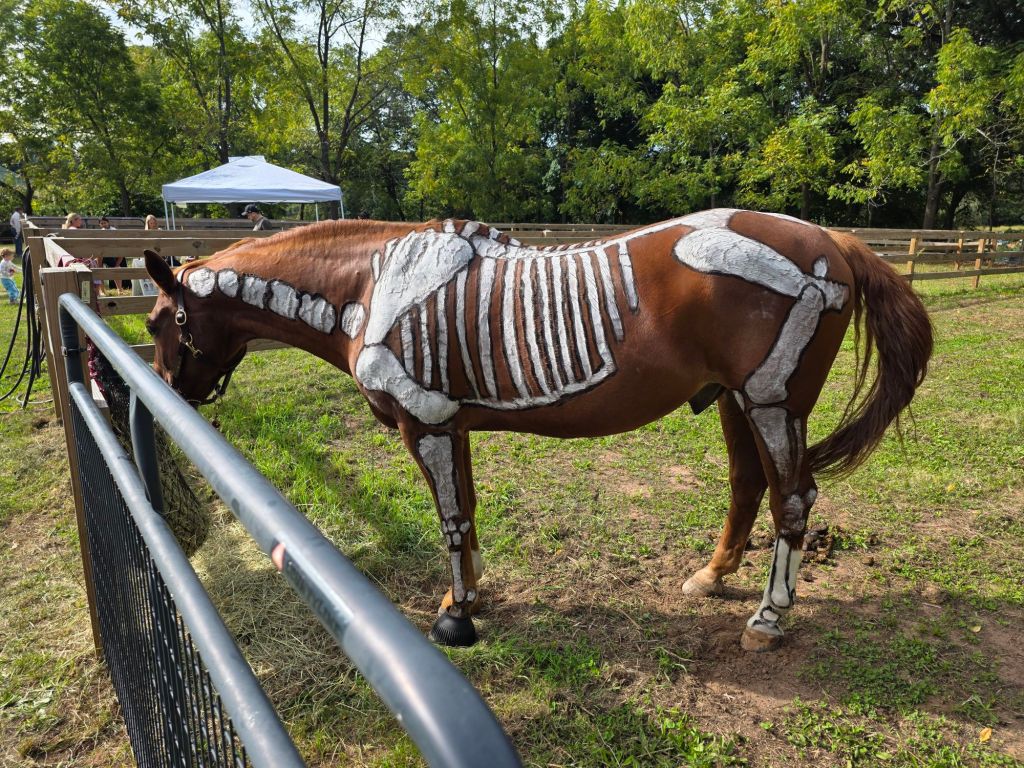
…but not because it was now finished. It had thirty years of static to burn through, and sitting still felt intolerable. So I began walking, then alternating running with walking. Low-intensity, steady movement provides the gentle bilateral cadence the body needs to metabolize circulating adrenaline without demanding performance. So I kept going. I drank, I ate on the go, and because I was well outside my normal routes, I saw funny things I ordinarily would not see. The weather was on my side. It was a gorgeous, autumn day.
By Saturday evening, the tally sat at 22.6 miles and 47,312 steps.
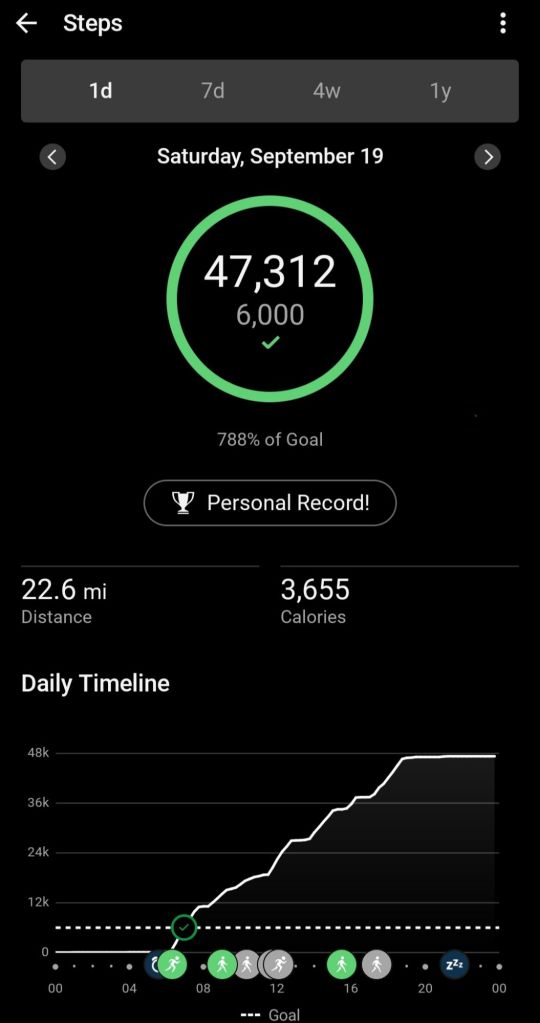
I slept with my nervous system empty. Much to my surprise, on Sunday morning, I woke shortly after 6am with a Garmin body battery of ninety-nine percent. Despite having logged forty-seven thousand steps the day before, my body practically shoved me toward the door before the clouds opened up for that rainy day I was hoping to avoid in the first place.
As I walked, my physical frame began issuing demands: “Stand up straight! Give your lungs room.” It repeated itself like a mantra. “Shoulders back. Chin down. Elongate your torso!“
…and then, as my ribs expanded, an old memory hit me with the force of a physical blow.
I married a month before my twentieth birthday, desperate to manufacture the loving, stable family unit I had never had. Four years and three months later, our beautiful son was born, and his arrival was the definitive end of that illusion. My husband was an engineer and an Air Force officer, but what I didn’t understand then was that we were drawn to one-another by a similar Mother wound. He, too, was subconsciously lonely and as a man, he also layered on insecurities I had no way of understanding. He was reaching for every distraction within his arm’s reach to escape himself. My baby was six weeks old when our electricity was shut off because bills went unpaid while he bought a Buell motorcycle. In case you aren’t familiar, that’s the speedy version of a Harley Davidson. No room for an infant car-seat or an ounce of situational awareness. My husband’s mother wound was that he believed if he was to feel contented and relaxed, he would amount to nothing; so he was always chasing the next material validation. I was married to him long enough to understand that would keep us in constant financial and emotional threat.
When my son was just over a year old, recognizing that we had no viable future there, I packed up our lives and moved alone with my son halfway across the country for a stable, family-friendly job. I explained nothing to anyone; I never complained about the real state of the marriage, so it was just too difficult after the fact. A few months later, I filed for divorce. It was agonizing. For the next thirty years, I cataloged that moment as the first rupture of my own making. I couldn’t look myself in the eye after that. I tucked the shame deep into the center of my chest, rounded my shoulders forward to guard it, and resolved that it was simply an ugly cross I had to bear for having failed at my only real dream…to have a loving family of my own.
As I sat down on a cold stone bench in front of a Connecticut Valley Colonial house from 1714, the real source of the tears finally surfaced. I wasn’t weeping for the marriage. I was weeping at the sharp, unvarnished memory of my own Mother. When my marriage fell apart, she didn’t ask me a single question. She didn’t ask what my life was like, how I was feeling or doing. Instead, she aligned with him.
My husband and my Mother became very chummy and all I got was how well they agreed on what an impossible, awful person I was. Calling that divorce at twenty-four years old a rupture of my own making was my grief turning itself into my terrible shame just to keep my psychological footing. If I had admitted the reality, that my own mother had actively joined forces with the threat while I was drowning with a baby, the ground beneath me would have dissolved entirely. To survive maternal betrayal of that magnitude, I took the blame into my own marrow. I caved my ribs inward, rounded my shoulders, and carried their convenient judgments as my own identity. From then on, she is who I was. She is the woman who raised my children.
In the last year, I have come to realize there is an entire generation of parents who nearly broke their backs trying not to repeat the passive abandonment of their own upbringing (“It’s 10 o’clock, do you know where your children are?”), only to find that their fierce, protective control created a different kind of wound entirely. That dynamic is what modern therapy flattens into unintentional harm, while leaving the parents wondering how their absolute devotion was experienced as a threat, or worse, abuse.
I can see myself now with painful clarity: I was perpetually trapped in survival mode, so I built a fortress. I recycled my survival skills as their road map for a successful life. I over-functioned, I maintained hyper-vigilance and enforced rigid standards. Since I kept marrying the people attracted to my capability and capacity and offered calculated support, I had to manage the household like a bunker. In my body, a single lapse in control didn’t mean a minor inconvenience, it meant the power got shut off, the resources vanished, and catastrophe and judgment arrived.
The tragedy of the bunker is the disparity in perception. I thought I was absorbing all of the battle damage by staying silent about how I experienced my Mother and my spouses. …but a child raised inside a fortress doesn’t see the war outside; they only feel the suffocating thickness of the concrete walls. To them, survival mode doesn’t feel like protection. It feels like an unbearable, high-voltage current of demands, vigilance, and tension.
I deeply understand their estrangement. I understand their visceral reaction to me, because it is the exact same autonomic recoil I feel toward my own Mother and each spouse: a nervous system demanding room to breathe.
After sitting on that bench this morning, arriving with the rain, another realization broke through my grief. My children did not internalize me the way I internalized my Mother.
Each time my Mother abandoned me, I swallowed whole her judgment of how I endured it. I sacrificed my own innocence to preserve the illusion that she was safe, while I was collapsing inward for decades. My children, however, refused to make that bargain. When they felt the suffocation from my survival armor, they didn’t collapse their chests or decide that they were defective. They externalized the boundary. They pushed my intensity outward and built a moat to protect their own identity. I am exceedingly grateful they did not develop my reflex to swallow poison and stay small. Beneath all the concrete of my over-functioning, the ferocious protection I gave them managed to provide enough structural ground for them to believe their own boundaries were worth defending. They have a spine. …and I am so proud of them.


Leave a comment