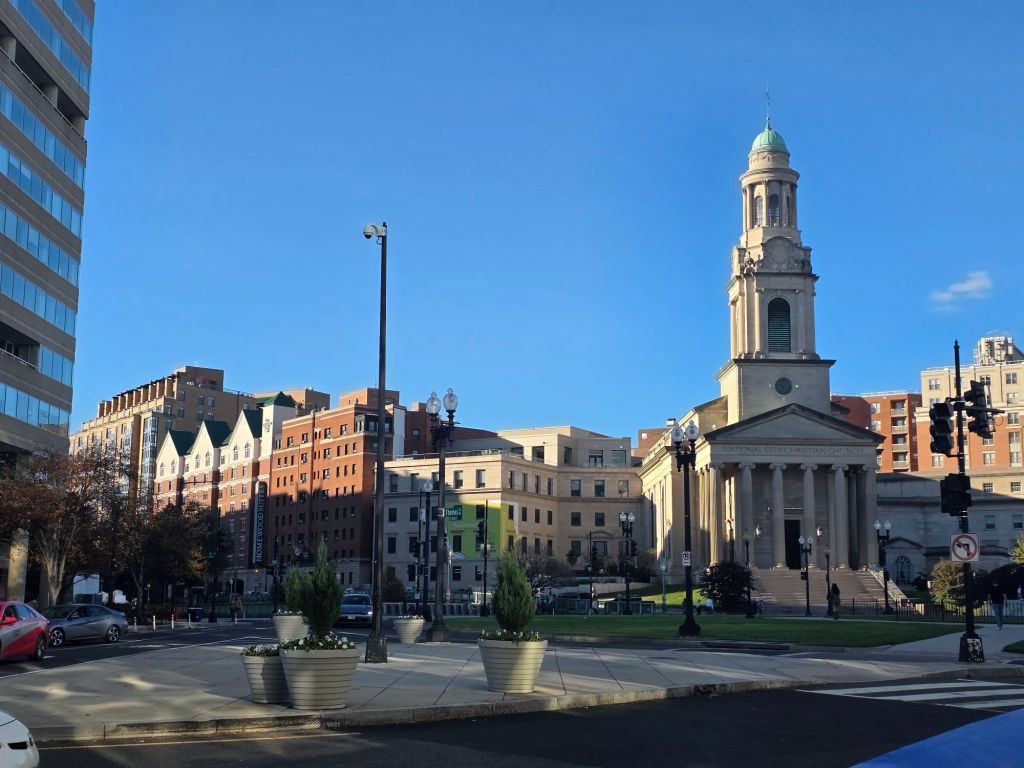
This week in Washington, DC, moving between conference sessions and various Association events, I kept walking past what felt like a looming monument to my most recent failures. It was the beautiful National City Christian Church on Thomas Circle, and I ensured I kept my eyes forward and my stride purposeful. After all, I know all too well how to soldier on, and I had a schedule to keep. Nonetheless, I could feel the building’s disapproving presence.
Days later, with most of the conference attendees long gone and even the last of the close-knit cohort that had hung around an extra night disbursing, I found myself drawn to it. Eventually, I ended up standing on the grass in the center of the traffic circle directly in front of it, with my roller bag beside me, ready to head to the airport. It wasn’t long before I was sobbing so hard, had it not been in a major city, I would definitely have been odd. I kept thinking I just need to move on along, but I couldn’t make my feet move toward the airport.
Every time I tried to pick up my bag and leave, a visceral, paralyzing panic pulled me back. My cells recognized the sensation. It was in the vein of the same crushing weight I felt at nine years old in Hungary in 1983, needing to leave my Mother’s flat to go to school, but absolutely fractured by experiencing her as if she was not fighting to be with me. At age nine, I had no choice. I had to override every screaming instinct in my nine-year-old body, especially the part of me that just wanted to be with her, and force my feet to walk to the city bus stop. That was the day my nervous system finally short-circuited. My training to sever myself from my own grief, put on a brave face, and walk toward what was expected of me, was complete.
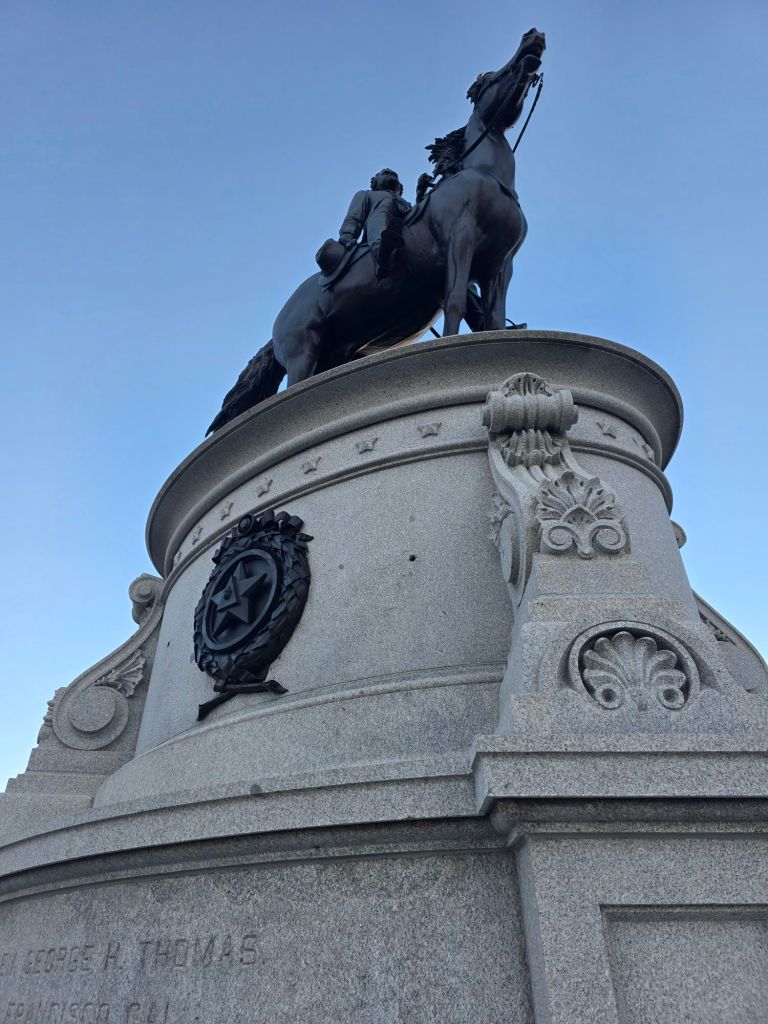
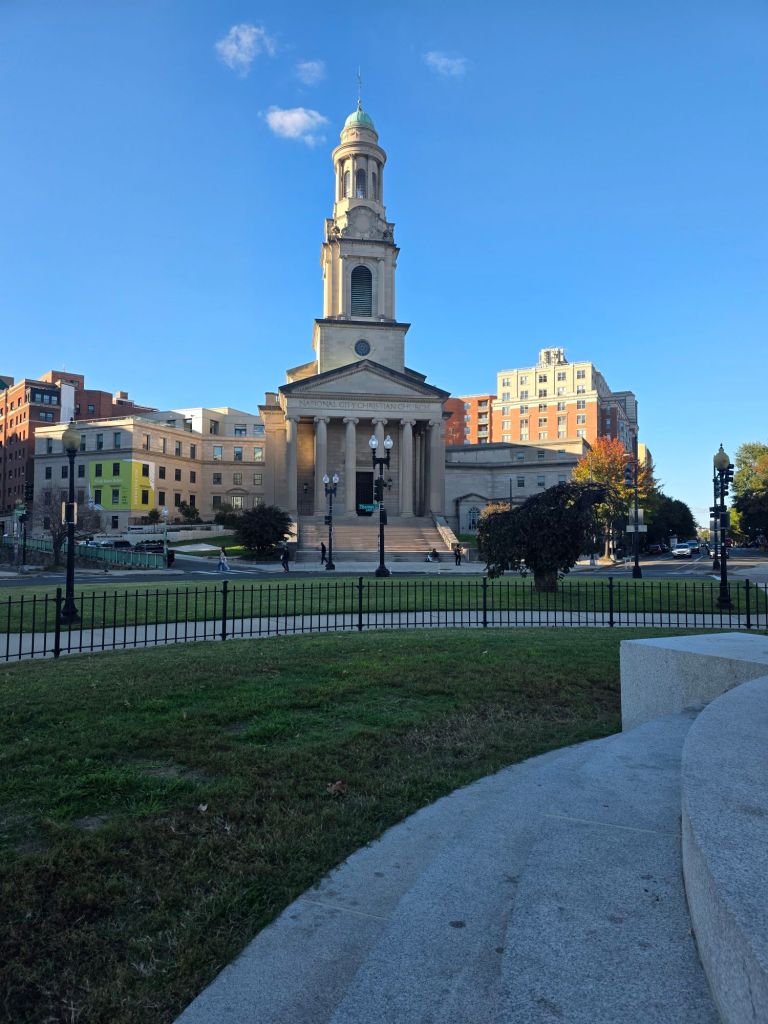
Today however, standing in the shadow of the bronze horseman in Thomas Circle, ordering myself to walk toward the Metro, my body staged a mutiny. It refused to do the 1983 walk-away. Looking across the lanes of traffic at the wide stone steps of that church, I was staring straight at June 2017.
That summer was my very first Washington DC Pride. I had just emerged from a years long, dark season of grieving a heterosexual identity and walking away from a marriage and a family structure that looked right from the outside, but inside of which I was slowly dying. I had spent years agonizing the impact on everyone, but especially my children, my decision to publicly acknowledge my sexual identity. By 2017, I had finally come to terms with who I was. Mesmerized by being newly out, I sat on those exact church steps until 1:00 am with a woman I was hopeful about, laughing and talking in the warm night air. Sitting on that stone, I believed I had finally arrived.
More than nine years later, none of that is true. Standing across the street on the grass of Thomas Circle, the grief of that contrast ambushed me. Why was I crying so hard over a memory nearly a decade old? As the tears kept coming, mercifully, new realization surfaced with it. Between 2014 and 2017, I really did take the time to grieve the loss of the automatic societal security blanket of a heterosexual life, including what all that implied for my children, each of whom had already experienced me bringing new adults into their lives, entirely out of their control.
In 2017, embracing my sexual identity, I mistook the euphoria of that relief for sovereignty. I stepped out of a dark closet into the blinding June sun and assumed that because I was finally living in my truth, the hardest part was over. I didn’t know then what I didn’t get to learn until this year. I hadn’t yet opened the cellar door of my own childhood to pull back the curtains on what it all had actually cost me. I carried all my family relational patterns, my over-functioning defenses, and my unexamined armor straight onto those church steps, draped them in Pride colors, and called myself whole.
Standing on the lawn across the street today, I realized I wasn’t just mourning the woman who sat beside me until 1:00 am, or the years that followed. I was grieving for the 2017 version of myself. I was aching for how hopeful and blissfully unaware she was of the deep, painful, excavating inner work that still lay ahead of her. My feet were glued to the grass because forcing myself to walk away to catch my flight felt like repeating 1983, severing myself from someone I loved (this time, my younger self) and marching off in compliance with a schedule while my heart stayed behind on the steps.
For a long time, I stood across the street, torn. I couldn’t decide if I should cross the traffic and actually sit on the steps that held truly wonderful memories for me, now turned sad. As long as I stayed across the circle, those stairs remained a monument to something I had lost.
Finally, I broke free. Instead of forcing myself toward the airport, I dragged my suitcase across the crosswalk, climbed the church steps, parked my bags on the landing, and sat down.
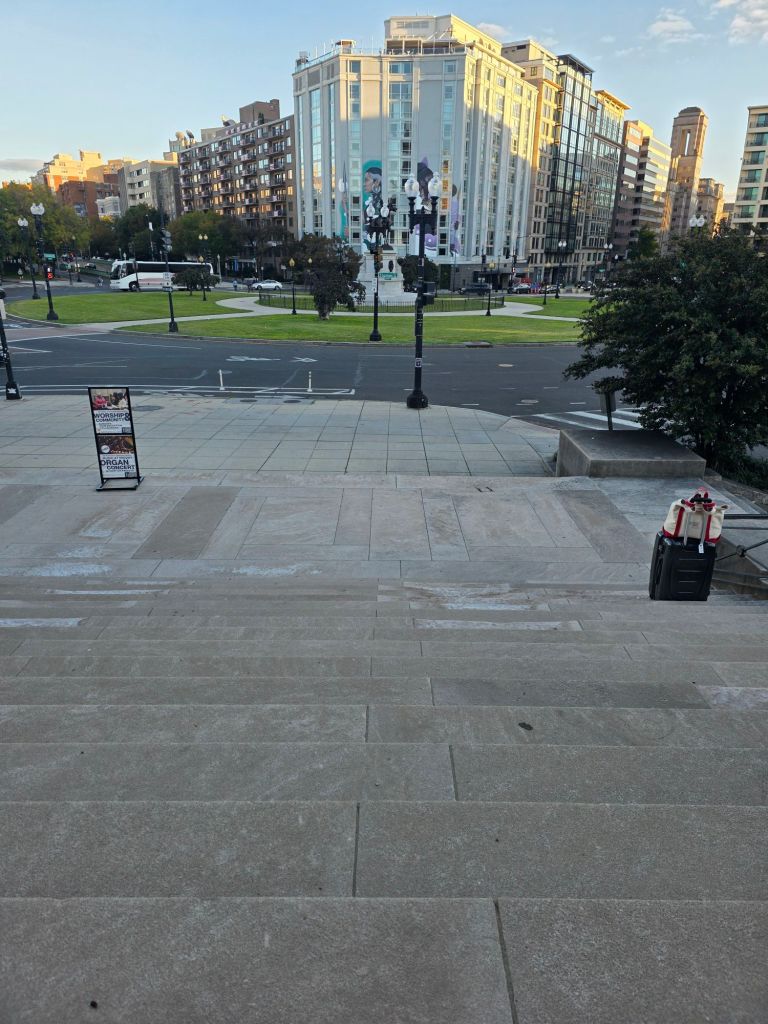
Almost instantly, the knot in my chest dissolved. I expected the October granite to be cold, especially since the sun had just dipped behind the buildings across the circle. Instead, as I placed my hands flat against the step, the stone was remarkably warm. The afternoon sun had been lavishing it with its rays all day, and the rock was still holding onto it, radiating that warmth right up into my palms.
Sitting there looking down at the traffic circle rather than up at a ghost, my entire perspective shifted. The joy I felt on these steps in 2017 wasn’t foolish just because I still had years of somatic and psychological excavation ahead of me. That joy was the oxygen I needed to survive the transition.
The sun sets on chapters of our lives, and the people we shared them with move on, but the small joys don’t vanish into thin air. It soaks into the stone. It soaks into us.
All of a sudden, my grief gave way to a profound sense of fullness. I felt rich in human experience and deeply grateful to have experienced this old church building as a source of wonder once more.
…and then, as if the universe wanted to wink at me before my flight, a movement down on the grass caught my eye.
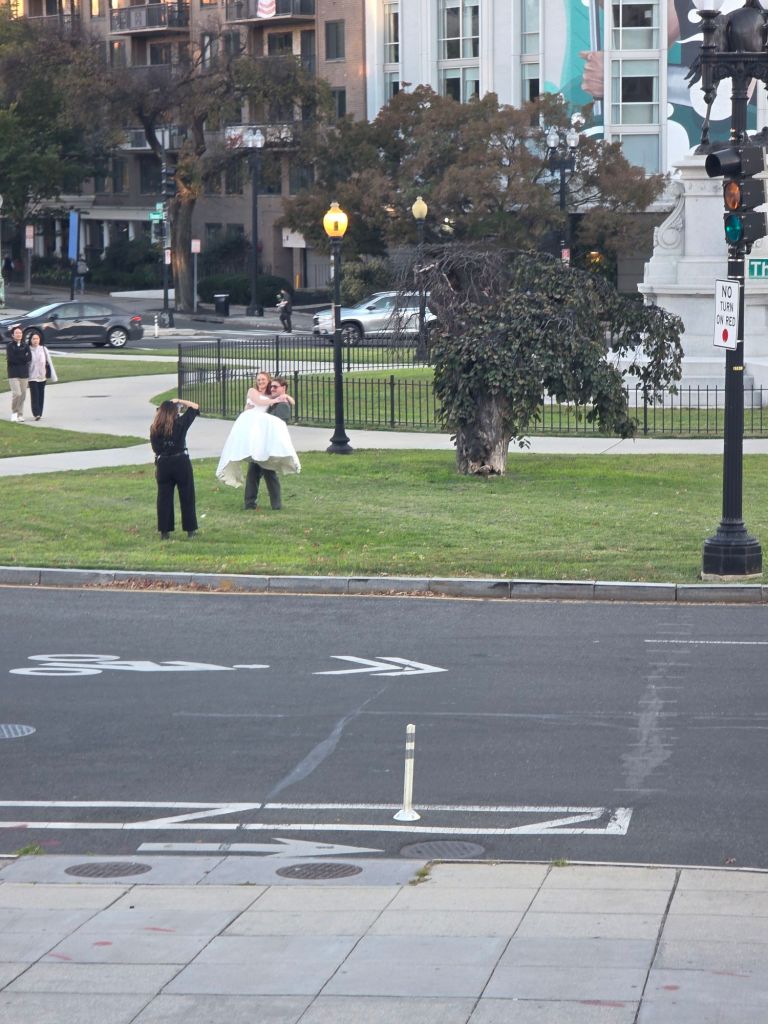
On the lawn in Thomas Circle where I had been standing and weeping twenty minutes earlier, a bride in a sweeping white gown and a groom in a dark suit walked into the frame with their wedding photographer. Down on the lawn stood two people at the very beginning of the big promise, dressed in the bright, unblemished hope of a new chapter. Up on the stone sat the woman who has lived the whole arc: the nine-year-old waving goodbye in Hungary, the nineteen-year-old bride, the slow dying of compliance, the heady 1:00 am Pride romance, the heartbreak, the relentless excavation underneath the rainbows, and the hard-won peace of finally coming home to herself.
I sat on the warm steps a moment longer, watching them pose in the golden hour light. When I finally stood up, walked down the steps, and headed to the Metro, I didn’t have to wave goodbye to anyone. This time, nobody was left behind.


Leave a Reply