Ultimately, most everything I know about my Paternal Grandparents is hear-say, save my childhood years during which I frequently spent one-on-one time with my Grandmother. As I earlier indicated, I’ll be changing names (if I use them at all) and writing what’s in my recollection, which means I am not claiming this is all the truth there is….it’s simply my perspective. I am also not attempting to replicate what one may read in a well-researched book about Hungarian history, but I will mention some world events as they impacted my Family.
My Paternal Grandfather was born in a rural village North of Miskolc, Hungary, in 1890. He was said to be quite tall (so is my Father, so I did not question this), and in possession of an always well-groomed, powerful, and artfully long mustache. By the 1930s, he was a well-established community leader, serving as a Circuit Judge and running a winery. It was only this week, coincidentally, my Sister in Hungary, mentioned our Grandfather had been married to someone before our Grandmother. I emailed my Father about it, and sure enough, my Grandfather was a widower in the late 1930s. I have one photograph of the man and lots of tales surrounding his alleged stern behavior, requirements for timeliness and orderliness, and his major fallout with my Father when my Father was a teen. I walked the grounds he used to own and cultivate for grapes. By the 1980s, my Father had managed to buy back some of the land my Grandfather had owned, but I’m getting ahead of myself.
My Paternal Grandmother was also born in a village North of Miskolc, Hungary, but in 1910. Twenty years my Grandfather’s junior! Think of the inequities there. She was no lightweight however, as she was the oldest of seven children and the only Daughter. She once told me she was such a scrawny, unpleasant infant, (ugly, to be exact), her Mother’s Mother almost suffocated her. The story she told went like this: shortly after her birth, her Grandmother sent her Mother to get something from down the street, and offered to stay with the baby, my Grandmother. My Great-grandmother walked by a statue of Mary and baby Jesus and had a strong urge to turn around and go back home. When she arrived home, her Mother was in progress of suffocating my Grandmother by pressing a feather pillow onto her infant body. Now let’s sit with this for a minute. Who was this seemingly monster Great-great-grandmother of mine and why did my Grandmother know this story? Why was she and why was I told this story? It’s horrific! …but let’s begin with the realities of rural, pre-WWI life in Hungary, or most any part of the world. Without a social-medical infrastructure, a sickly child is a tremendous threat to the survival of a Family. I am not justifying actions, I am merely bringing context and one perspective, as preserving the life of one can jeopardize the life of many, and it must be an excruciating situation in which to be a decision-maker. In fact, this is precisely how it was presented to me then, and many times during my childhood, thereafter. My Father would detail the moral dilemma of the seven-person life boat, already at maximum capacity. “If another person in distress swam up to said boat, what would you do?” he would ask.
Back to my Grandmother, I am not sure what it’s supposed to do for a child to know she was unsuccessfully suffocated by her Grandmother, and that her Mother saved her. I can only imagine what it would do to her psyche. Then multiply that, as I too, was brought in on the Family realities of 1910, before I was old enough to fully understand some of the words, let alone how to procees them.
My Paternal Grandmother told stories of shoes as optional during her childhood, as between all of the children, they had one pair. She spoke of hand-me-down items during her younger years and that she worked hard to help her Family in their day-to-day living, as farmers. She was still in her single digits when the Great War came to Hungary. She had a matter-of-fact way of talking about her childhood; her increasing levels of responsibility before she even finished schooling wasn’t unique in her village or among her peers. She described her long and beautiful wavy brown hair when young, and she said it went below her knees. We have to temper that description with her height however, which was about five feet two inches. She held a regional record for her hair, and at some point in her life, that long hair served as income when someone came to her village to buy her long hair to be made into a wig for a theater. In my memories, her hair was always a chin-length bob of sorts, with no bangs, a long-worn middle part, bobby pins on each side, and waves that looked like the finger waves of a particular era, except hers formed by happenstance. I don’t believe color or heat ever touched my Grandmother’s hair, and I vaguely recall some of the natural things she did to keep her hair shiny, even as she aged.
She, too, was married before my Grandfather. Her first Husband was probably more her age and she may have even liked him at some point, but during the marriage, she found out he was a horse thief. Not just any horse thief, but one who enjoyed the heist, just to return the animal in the morning. What an odd story, and my Grandmother was sure to explain his impact on her, as it was a behavior that continued and became highly (socially and economically) destructive. My Grandmother decided in the early 1930s, while in her very early twenties, to divorce him! That was unheard of back then. It would take her nine (!) excruciating years of her precious youth to secure a divorce, but she was successful. While she awaited her divorce, she was likely very lonely and shunned to a large degree, as society sharply scrutinizes an unmarried woman over twenty, no matter what her circumstances (now women at least get some leeway to age thirty). Worse was the woman who dared to initiate her own divorce! She did have a key enabler of her own however: she showed great promise and interest in sewing. Not just any sewing, but working with wools and gaining a marketable skill in precise tailoring. This ability to make her own money gave her options and independence few women of her era had, and she clearly had the confidence to make it work in her benefit. It’s this piece here that was seared onto my brain early on: my capable, fierce Grandmother, who overcame so many obstacles to be the woman I spent time getting to know, when she was in her sixties and seventies, in the 1970s, into the 1980s.
Merging their lives together, I know my Paternal Grandparents married in 1939, and she moved into his well-established household. It was considered a nice house in the economical center of the county in the hills of Northeast Hungary, with ample property along with it for livestock and gardens, fruit, and nut trees. It’s difficult to fathom their relationship, but some mutual regard must have existed, even if it was largely utilitarian. I did hear characterization of my Grandfather as very schedule and function-driven; warmth was likely counter to his projection of an overwhelmingly orderly persona. To illustrate my Grandfather’s rigidity, I often heard reference to his expectation lunch would be promptly on the table for him by Noon, if not, he’d leave to eat at the local restaurant instead. Some of that may have been cultural however, as evidenced by this old kitchen towel which effectively reads: “It isn’t quite Twelve, but lunch is all ready for serving!”
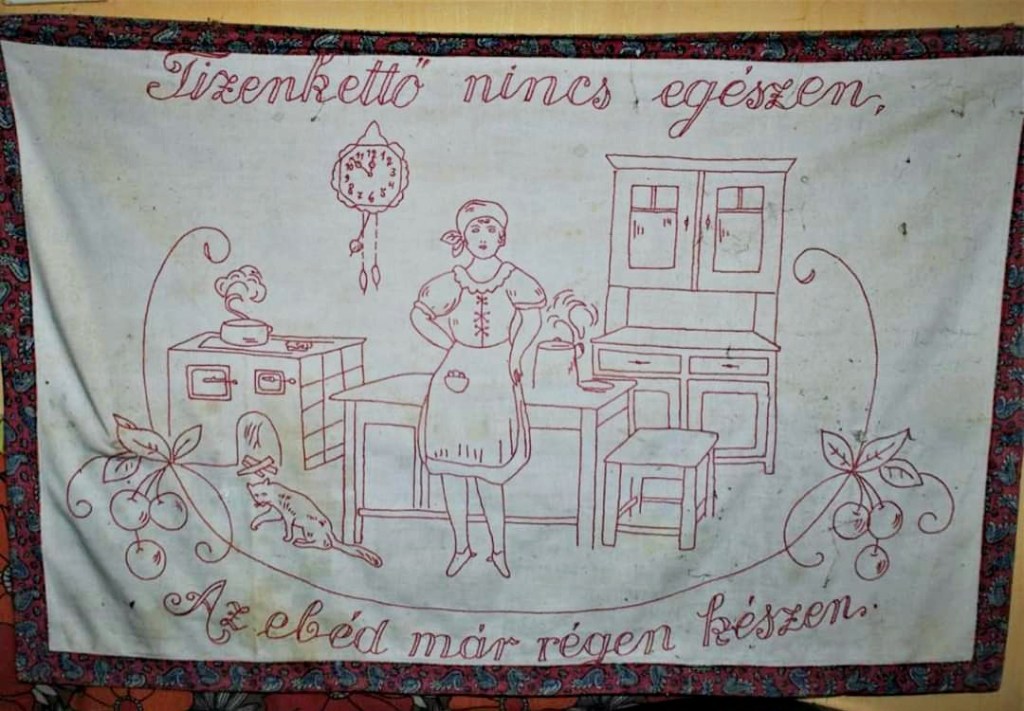
No fairy tale romance here, nor was I ever handed down an expectation for one, for which I’m grateful.
My Grandmother was considered a geriatric pregnancy when around 1940, with WWII raging in Europe and Hungary, she gave birth to a Daughter. She must have been right at age 30 at the time. Years later, she spoke very clinically about this Daughter, who, out of the human and nutritional challenges of the time, was born with open spina bifida. It’s difficult to know what transpired in the first and only two or so days of life for this little girl, but I was told she didn’t survive. I can only fill in blanks here, and as a Mother, I still cannot quite imagine the circumstances under which my Grandmother had to make decisions and thereafter endure this period. I am grateful I have never been faced with her reality at the time….brutal ground war that stretched for years, scarce supplies, zero medical help in a rural setting, a vulnerable newborn struggling for life endured by an irreversibly heartbroken woman. Her Husband would have been of no support, and she would probably sense this was yet another grin-and-bear-it event. I think things permanently become rewired in a person to be able to reconcile such a loss. By late in 1941, with war even closer impacting their village, my Grandmother gave birth to my Father, in the back room of their house. He would prove to be her only living child.
My Grandmother detailed very scarce conditions during my Father’s first years of life, with WWII now fully in their backyard, troops of all uniforms (country affiliation) came through their village on the regular, looking for food, supplies and sadly, young women. My Grandmother spared me graphic details, but she said they hid their crops and the village’s young ladies the same way: underground, under hay, in crevices of all types. She spoke of one incident when she and some older women had been surprised by soldiers coming through, had no time for other arrangements and were actually sitting on a pile of hay waiting for the looting solders to move on, when one of the young ladies in the hay almost suffocated. My Grandmother was likely assumed older than she was because of her Husband twenty years her senior, or she didn’t care to tell me she herself was physically threatened, but she made it clear the soldiers were ruthless, and she made it clear the uniform affiliation made no difference. Now let that sink in.
There was another story about why my Grandparents had three massive weeping willows surrounding their home: high groundwater. The property was situated with its front gate facing the main street of the village at its business center, then extended up lengthwise through the side of a hill. The house was built from traditional materials of the time and place, a mixture of mud and clay, highly porous but vigorously stubborn. With its seemingly twelve-inch wide walls, it stands today. This was the first time I was taught racist thoughts; up on that hill, inconvenient to any jobs, water or shopping, lived the Gypsies. Today, they are known as the Romas, but then, it was the Gypsies I was to learn to fear, look down upon, and to whom never, ever speak. More on this later. Back to the porous house, it was plagued with high groundwater. In fact, as a child, I could always see how high moisture had wicked over the decades, like rings of a tree. My Grandmother told me early on in WWII she and the neighbor had collected heirloom clothes, linens and other precious items and buried them in the ground under their house. I was old enough when I heard this story…I remember thinking she is going to tell me how the neighbor dug up their jointly hidden belongings and made off with them, but that wasn’t at all what happened. WWII lasted many years and in that time, their hidden treasures were soaking in groundwater. When they dug up the containers, opened and began to pull on tapestry and linens, it all smooshed into a doughy mess; present, but ruined. I still remember my Grandmother’s muted delivery, and also my realization this was another loss. She wasn’t clinical in her recall this time, she was simply defeated, even 35 years or so later.
Then comes 1944 and 1945, and with them, major changes in my Grandparents’ lives. Historically, when a new government takes over, it rapidly dispenses with the officials of the former government, no matter at what level. Dispensing in this manner can mean releasing from a role up to and including high-profile execution. When the Russians ‘liberated’ Hungary to signal the end of WWII, they ushered in the Communist Government, and its newly appointed officials. Someone who worked in a factory one day was the new mayor and the old mayor was either dead or otherwise broken.
Unfortunately, my Grandfather had been a Circuit Judge in the pre-Communist government, so upon the appointment of Communist Officials in their county in Northeast Hungary, the inevitable was about to happen. My Grandparents were already hearing of executions and ruined lives, and it wasn’t long before the knock was at their house’s front door. As my Grandmother explained it, the men of the newly formed local Communist Government ripped them out of their house, drove them outside of town and presented them with my Grandfather’s hanging noose. Ultimately however, they were alive the next morning (although my Grandfather had been beaten), possibly thanks to the fact that they were in a village where everyone knew them, had benefited from their skills at one point or another and therefore some personal resonance and some form of mercy crept in. My Grandmother wasn’t quite sure how they came to be let go, but in some ways, I sensed parts of her did die that night. There were to be consequences, however, and here was my data point number two for why it was lifesavingly critical for a woman to have the wherewithal to make her own living. At age 55, after a long tenure as Circuit Judge and Winemaker, my Grandfather was spared his life, but ripped of most of his property, all of titles, affiliations and community standing, and sent to the nearby coal mine to join the waist-deep-in-water, physical labor ongoing there. There was an overwhelmingly complex way in which my Grandmother would talk about this; she was deeply resentful she and my Grandfather were supposed to be grateful to be kept alive, but it was only to suffer the shame and toil of saving their house (what they got to keep), recover from the senseless destruction and loss of their grape fields and wine-production facilities, and move on in a new social contruct in which they were political and social pariahs. My Father was four when his Family’s life was shattered, but he came of age with a Father and Mother on whom the ten years post-WWII had taken a heavy toll. My Grandfather was chronically ill, now 65 and still forced to work in the coal mine. My Grandmother did nothing but sew, sew, day and night. It was her sewing, her fine tailor work that kept the Family afloat, and allowed my Grandfather to have some dignity. The relationship between them had to be very challenging.
At age 14 or so (1955ish), my Father was admitted to a college-preparatory high school. This was a massive feat despite my Father’s aptitude, given how the Communist Government was careful to also limit the progression of the offspring of former government officials. My Grandfather was very intent on my Father getting an education, and often attempted to motivate my Father by pointing out working in waist-deep water in the coal mine was a very difficult way to make a living.
I was told my Father and Grandfather often had disagreements, and that my Grandfather thought my Father was very concerning in his stubbornness, in his psyche, but it’s difficult to gage whether this Father-and-Son relationship was much more tumultuous (and reportedly, violent) than what was within the normal of that time and era. The impression I was left with however, was that my Grandfather was done with trying to mold my Father, and shut him out, while my Grandmother continued to both financially and emotionally enable his aspirations and demands. What a difficult position she was in. Her only Son was, despite his shortcomings, the only relative in her life, besides her aging, ailing, Husband. I am not sure at what point my Grandmother’s own Family and especially her six Brothers disappeared from her life, but it seems when she married my Grandfather, they may have been left behind in favor of my Grandfather’s preferences he may have also asserted at the time of their marriage due to his relatively higher social and financial standing.
My Grandmother took care of my Grandfather in his last years, continuing her business, now as a Master Tailor, keeping many students around, making income that way also. My Grandfather passed in 1967, at the age of 77, remarkably. My Grandmother took faithful care of him, even if only out of a sense of duty and pride. His last years he spent in a standoff with his own child, and worried this Son would influence his Wife’s decisions about her home and her financial viability after his death. My Grandfather wanted my Grandmother clearly in control of her assets and life and saw a liability in my young, then 27-year old Father. His grave is beautiful and withstood the last five decades, but contains no dates nor inscriptions. I remember going to his grave with my Grandmother, even painting with her the wrought iron fence around it.
My Grandmother appears to have led a lonely life after my Grandfather passed, but she kept her life full with her Master Tailor business and her students, creating everything from custom suits to theater draperies and baby christening gowns. …and her flowers! Her flowers!!! The most tended yard full of them, and a constant source of pride for her. She re-purposed (today, we’d say upcycled) small-truck tires and painted them her favorite color green on one side and their circumference. She used those to make self-contained flower beds, in addition to the large flower bed in front of and the foot-wide flower border along the entire length of her house. Her yard was always immaculate but never over-groomed. Dandelions and other grassy things I later, in the US, came to be told were weeds, happily made up her lush lawn. I thought of her yard as a my-size park back then. Things changed at the middle fence, however. That section, immediately behind the house, was for livestock, and while she only had chickens by the 1970s, she still had her trusted German Shepherd, and he terribly frightened me. He never once as much as licked my hand, but his sheer credentials with my Grandmother made me see him as very capable, important and powerful. Her equal. She fed him raw meats and praised him for being smart. He was a real dog, a working dog, she’d say. My challenge was that I was a city-raised kid, and my Grandmother’s outhouse was already strange enough, on top of that, having to access it while not getting her security dog’s attention, was downright stressful. As the 1970s wrapped up, my Grandmother finally got one waterline into her house. Until then, she had been carrying water from her own well, at the front of the property. At least, this was one positive aspect of high groundwater.
I have memories of relaxation and memories of tension there. My Father, an Accountant turned Attorney, welcomed the outdoors and sunshine there; one very pleasant memory I have often thought of throughout the years was my Father in his suit as usual, sitting backwards on a chair outside with his back toward the early Spring sun, soaking up its rays. My Father and Grandmother also arranged for me to get to experience what grape stomping was like in the days of the winery, with grapes from my Grandfather’s original land, in a large wooden cask-like vat. I had to wash my feet, then they plopped me in there and I could goof off stomping around and see the grape juice run out of the spiket installed on the vat’s side. I don’t recall we drank any of it; it was for the experience of squishy grapes between one’s toes. Years later, I saw the I Love Lucy episode in Italy and had to smile.
My unpleasant memories range from my Mother making me practice the cursive Hungarian alphabet for what seemed like hours (I am confident it wasn’t), while I was sure it was just a ploy to keep me busy and out of the way, to witnessing my Father shouting at my Grandmother.
I believe my Grandmother did her best to love me, the way she knew how. She cooked the most delicious foods of my childhood and an amazing variety of them, including intricate desserts, all from scratch. Now, this wasn’t the cooking methods of the French Court; these were hearty, rich Hungarian foods made with the freshest ingredients. For example, walnuts and chestnuts only grew once per year, for example, but she could do magic with them. I would sit by her side as she cracked eggs into a blown volcano-shaped pile of flour and began to make pasta. I sat there until she cut every kneeded and rolled pasta strip into tiny squares, the Hungarian way. She showed me the inside of a very fresh chicken’s head while talking about all of the chicken in a very educational manner. Her relationship to the chicken was that of understanding she had taken care of it so it could nourish us. She made an incredible dessert out of walnuts, cookie crumbs, and rum; she put them in a wooden form to make towers of them; this wooden form looked a hundred years old to me. Now, these forms are made from plastic. What a shame.
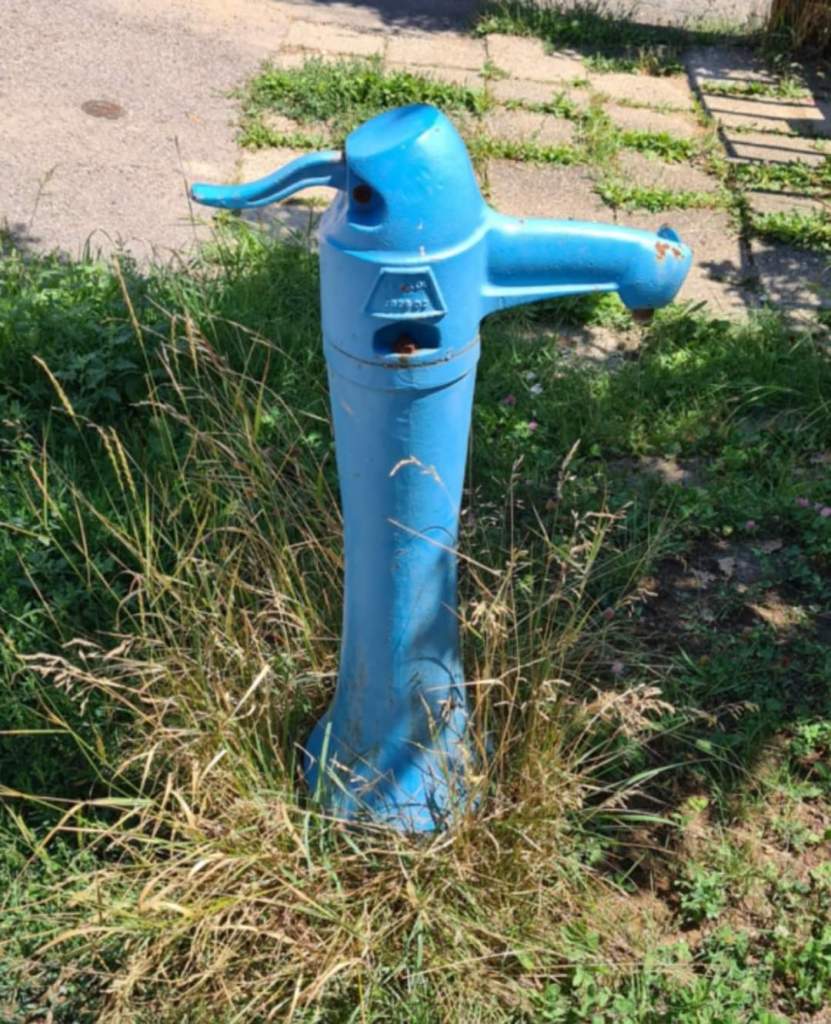
As far back as I can remember, most Sundays year round, we drove to my Grandmother’s house from our downtown Miskolc concrete high-rise. It was a pleasant thirty-minute drive and served as a porthole to nature. When we arrived mid-morning, my Grandmother would already be well-accomplished in her day, cooking from scratch and preparing what seemed like twenty different things to soon culminate into a Family Sunday lunch (the primary meal of the day). I was in a pretty good bubble there, and for the most part, my Brother, who is nine years older than I am, liked it there as well. He did have chores to help our Grandmother from time to time; like all teens, he wasn’t just downright excited about those. My Brother and I took turns staying with her in the summertime. It’s not that we were there for very long at a time, but that we weren’t there together. I liked that. I could feel her joy when I stayed with her, as much joy as a woman who constantly seemed in psychological survival mode could muster up. She seemed to get joy from her flowers, cooking on Sundays and having me around one-on-one. My Mother once remarked my Grandmother’s food had made me a chubby toddler. …but in the pictures from that time, I saw a happy kid with a single roll on each arm and thigh. My Grandmother loved cooking for me; it was her form of affection (unfortunately, not hugs), and I loved eating her food, my entire childhood in Hungary. My Grandmother would periodically come into Miskolc, to our flat, to spend time with us and take a nice bath, for which she didn’t have to fetch and warm her own well-water or from the public water pump down the street.
As I got older, so did my Grandmother, of course, and I could see the changes…she made less elaborate meals and she didn’t get a new German Shepherd when the one from my younger years had died. I must admit, I was relieved about the clear path to the outhouse, as I was aging out of the chamber pot my Grandmother would set out each night for me, and without mention, clear away each morning. She was beginning to heave her massive feather bedding with less gusto. She kept no more chickens, her conversations with my Father seemed more explosive, and she looked more tired, even desperate. She did, however, keep up her sewing. It seems her sewing was always in demand.
I was around age seven when I began to realize just how difficult my Mother’s relationship with my Father’s Mother was. Well, also I was forced to see my Grandmother in a different light by my Mother’s narration of events I saw, arguments, in which ultimately, my Father was yelling and I was to be invisible, I was glad to get to pretend to be invisible. My Mother routinely cast an adversarial light on my Grandmother, and seemed to not have regard for my age, nor my autonomy as a separate human, with a right to experience my Grandmother as I did, in my childish ways. The best I could understand at that time, the arguments were about my Grandmother legally turning over control of her hard-earned assets to my Father for his ownership in name. It’s difficult now to untangle what I was told and what parts of it I understood when, but there was intense stress around this would-be inheritance between a Mother with no relatives and her only child; an extremely devastating dynamic no one knew how to handle, only to inflict more Family pain.
My best assumption around why my Mother’s feelings for her Mother-in-law soured had to do with just what a solid, example-setting presence my Grandmother was in her Son’s life. She worked endlessly and tirelessly, and seemingly had the strength and determination of a dozen people, while probably not thinking the same of her city-raised, very feminine and in her young twenties, not at all handy Daughter-in-law. By the time I was fourteen, I had realized my Grandmother was quite the woman, even in Hungary, a country historically quite well-stocked with capable women. …and she gave no slack to women who seemed not to want to be self-sufficient, who complained, who didn’t seem to be built to land on their feet. This sentiment had to be ever-present for and intimidating to my Mother, not to mention my Father’s role as the only Son to a proven-fierce woman who keeps generating cash, and within flashy power-struggles, still seems to call more shots than my Father does, let alone my Mother!
My Grandmother’s health was further deteriorating by the time I was a teenager, and I remember learning more about her medical history, then. A few years after my Father was born, shortly after WWII, my Grandmother had a very serious medical emergency and was taken to the nearest town with a hospital, in a horse-and-buggy. What an excruciatingly long and bumpy ride that had to have been. She was said to be hemorrhaging from between her legs. The decision to take her was made late and her Husband, already a widower once, didn’t think she’d survive. Thankfully, medical doctors and facilities at the time didn’t care who was who or how they’d pay (it was Communism with full medical care benefits for all), and they got to working. This was before 1950, but they knew, despite seeing my Grandmother’s uterus engulfed by a tumor, not to also remove her ovaries. Further, they connected her ovaries to blood-supply, so they would survive and function. What a contrast to the US practice of wiping everything out, so to speak. She regained her full health thereafter, but permanently closed the window on childbearing, even is she had been brave enough to buck social norms and have more children in her late thirties. In her seventies in the 1980s, her long-struggle with the inability to digest food became so acute, my last memories of her are her meal of bland chicken, table crackers and tea. Many years later and armed with some genetic information of my own, I wondered if she was suffering from Celiac Disease or Crohn’s.
My Grandmother passed at the age of eighty-two, of ovarian cancer. No, I don’t believe the doctors forty-some years earlier made a mistake. The doctors who kept dismissing her stomach pains in her late seventies did. Eighty-two is quite remarkable however, especially given how many brushes with death my Grandmother experienced. She had a complex, demanding, dutiful life. She was given no tools, and no emotional support; she only had her pride in her skill and endurance. She managed to have a Son who was never quite content with her nor with himself, despite all she gave, and three Grandchildren, of whom she really only got to spend quality time with two. None of them were ultimately taught to appreciate her in real time, including me.
I felt like my relationship with my Grandmother continued after her passing, and I frequently felt her very intense presence as I progressed from my teens to my twenties and became a Mother. She seemed to move with me; I could sense her even as I frequently changed residences in my twenties. I could feel her in the house I gave birth to my Son; like she gave birth to her Son at home.
Over the years, I had only longed for one think of my Grandmother; her earrings, but my Father chose to give them to my Sister in Hungary. It was in September of 2023 my Sister gifted our Grandmother’s earrings to me. Having those now with me is a wonderful reminder of the many facets of my Grandmother’s life and being, along with mine.


 One More Perspective
Leave a reply to Joy – One More Perspective Cancel reply