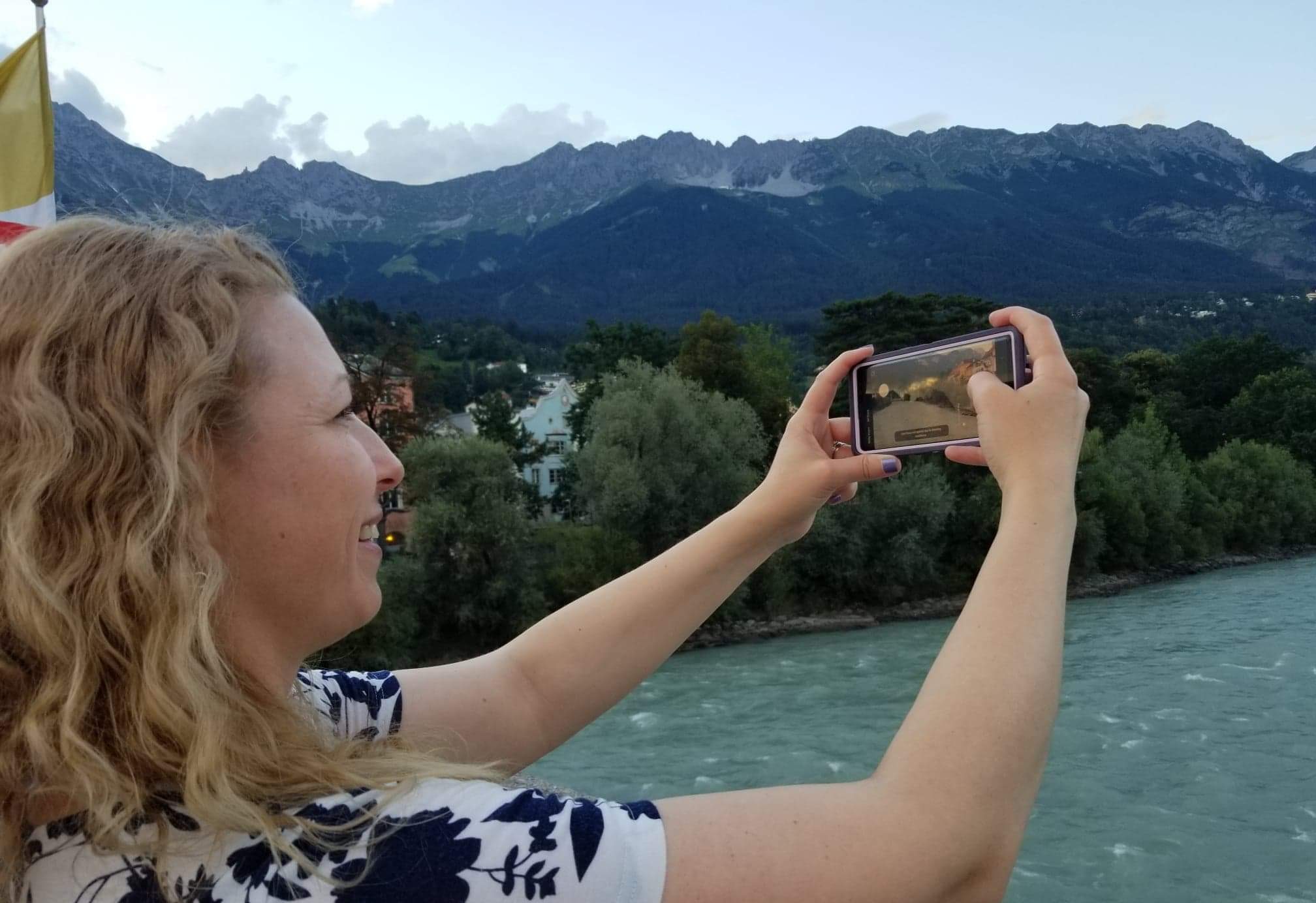
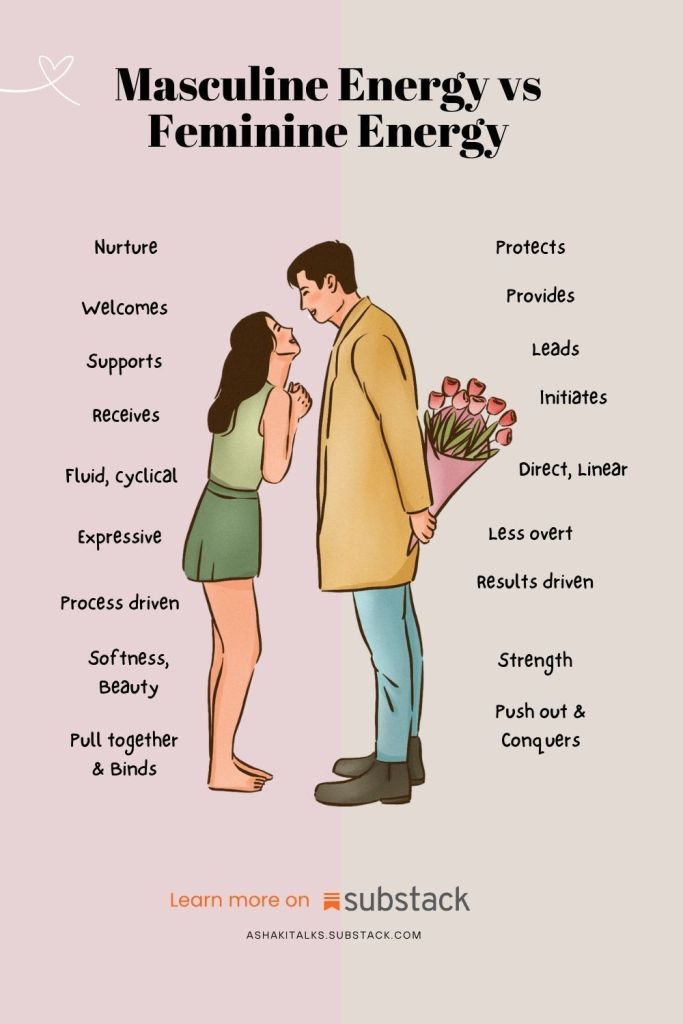
In the LGBTQ community, the out women tend to fashion their exterior to match their desired interior. Begin by thinking a bit in terms of traditional gendered presentation and societal roles, like in the uncomfortable image below.
In the lesbian community, those stereotypically feminine and masculine characteristics are represented on a spectrum or scale. The intent for most is to signal to the world the degree to which the individual identifies with the traditional roles; what blend of feminine and masculine traits they see as applicable to them.
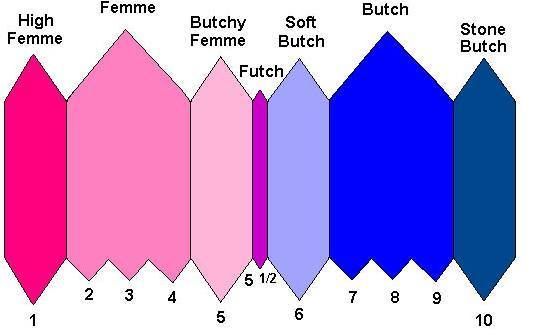
Presumably, the higher the number on the femme-to-butch scale, the more qualities the person embraces from the masculine side. In reality however, it quickly gets complicated, nuanced, messy; and for some, offensive, outdated, and altogether irrelevant. It’s important to realize these scales, labels and spectrums are only applicable to the people who find it so. Humans are infinitely complex and when internally fueled, are capable of immense transformation, so I deeply respect the outcry against the very labels, spectrums and frameworks I leverage to make sense of the world from a drone’s view.
Since I was a late-arrival to the LGBTQ community, I was over forty years old in a heterosexual marriage raising three Children, these scales helped me to orient myself. I first used them to map myself. Not my work persona, the engineer, the manager, but in my personal life where I knew I had never quite been able to select the partner with enough constitution of their own to not be frazzled by my energy and abilities. Eventually, I used the gender-role scale to arrive at my own definition, well on the feminine side. Despite what some people believe they see of me, I love knowing the people who have a strong sense of themselves and who can, without resenting me for my perspectives, hold their boundaries and communicate them in real time. I got to experience that in an elementary school Friend early on in my life, and we are still close Friends, across decades and continents. She’s an Imago Turtle naturally, which adds to the value of what I’m about to highlight. I love her ability to listen to my impassioned advocacy for a particular perspective or solution, engage with it, ask questions, look at me with understanding this is me caring about her, then peacefully tell me she will do it her way, in a manner that is representing herself, acknowledging my different take, and is ultimately about her, and final. I recently had a series of similar experiences with another long-time Friend, also a self-identified Imago Turtle, and I loved everything about it. These people are my tribe (Imago Turtles or Octopi), those who engage but do precisely what they need, changed or unchanged by my points. I have even experienced Friends who can stop me on a roll to say to me: “I know, but I can’t.” I so appreciate that honest expression of “I know you mean well but I don’t want to hear it, I love you and I know you care very much about me, but I will just proceed as I am.” Whew. I love that clarity. Must it be a luxury?
Returning to these identity frameworks…what they don’t capture is that not everyone possesses sufficient self-awareness to reliably match their exterior to their interior, which means what you see isn’t necessarily what you get. Relying on aesthetic signifiers to predict emotional capacity is a fool’s errand. I am that fool. I have learned in the recent years in the LGBTQ community, it’s possible to perform the characteristics associated with the projected appearance, but under that facade can be a whole other complex set of realities. Actually, I think that applies universally, regardless of sexual orientation. “Sometimes the clothes do not make the man” sang George Michael. OK, wrong example. All this to say, by the time I was ready to embrace my sexual orientation, I knew I couldn’t afford to form a relationship with someone who didn’t have the wherewithal to hold their own. Academically, I thought my sweet-spot would be in seeking someone who identifies masculine of center, naturally possessing the traits of leadership, directness, learning, and if I’m truly honest, even protection. I’m not talking about anything radical, just meeting me half way, speaking up, having skin in the game, not relying on my emotional labor only. I was seeking a strong constitution to meet my strong constitution and form an equitable partnership. My critics say I want a pushover. My life experiences say my mental health requires the opposite. Unfortunately, I do naturally attract those who want to benefit from, consciously or subconsciously, my ability to provide structure, to lead and be decisive (and then to resent me for it…sigh). I was using the femme-to-butch scale as a shortcut to finding my possible pool of individuals for the likely best pairing. What could possibly go wrong? Oof.
Humans are layered and nuanced, full of bias and wishful thinking. Especially in favor of themselves. Me, too. That’s why this website is called One More Perspective and not Universal Truth. I’ve learned long ago there are many parallel realities, therefore many parallel truths.
So what happens when someone, while single, presents themselves on the femme-to-butch scale as masculine of center, but that only works while untested by the realities of an intimate relationship? Or as a femme, puts significant effort to dress up while dating, but gears down to perpetual sweatpants and no glamour once coupled? Perhaps those don’t have to result in anything dealbreaking, but what if they make all the difference in the world? If the persona of a Partner was a mask and not a character trait, then the person you married doesn’t actually exist. It happens. …and I’m willing to believe most of it is completely unconscious. While one’s exterior changing is inevitable over time, when the internal realities assert themselves, they can be jarring. Those aren’t in the same league as no longer installing faux eyelashes or a push-up bra.
I just had no idea I would fall prey to someone’s wishful thinking about themselves and then my childhood programming would take over to enable, to power really, the entire dynamic instead of halting the bait-and-switch.
Some would say time and conflict will reveal who someone is. Surely. …but what happens then is another variable. That’s when the Imago Relationship concept steps in, and the couple, regardless of gender or sexual identity, begins to engage in a much more raw form of psychological dance. They begin to default to their childhood programming and engage their survival instincts. Enter the Octopus and the Turtle baselines. Navigating this requires very healthy individuals, willing to represent themselves and maintain good will, as well as to genuinely commit to the nurturing of the other through consistent relationship repair. Oh, that repair. Washing dirty dishes, as I like to say. That emotinal maintenance, that desire for reconnection following a relationship conflict, can be as elusive as Banksy.
Now for the controversial title of this piece. It came from someone who has been an out member of the LGBTQ community for many more decades than I have, and who has ties to the generation who constructed their adult lives before Ellen, and any societal support and acceptance. She told me about The Transformer, a phenomenon understood as the woman who presents herself one way on the femme-to-butch scale but actually defaults to the opposite side. Fuck. Where was this information when I needed it? After I laid it out like this, someone may say: “Yeah, sure. Makes sense this may happen.” Ugh. Thanks. Not helpful. No one explained it to me like this and I was too new to the community to understand not all LGBTQ people arrived where they are by processing the societal expectations and pressures the same way (or at all). Hell, some operate from a place of internalized homophobia! Can you imagine the internal fracture that causes? In any case, I am focused on understanding how I specifically walked down a primrose path that I stuck to despite it turning into my emotional nightmare, and I am committed to preventing it in the future.
The Competence-to-Collapse Pattern
Phase 1: The Presentation of Capability
The Persona: A new partner presents as highly capable, self-sufficient, and perhaps even protective. They often adopt a grounded, stable exterior that suggests they are an equal peer in managing life’s logistical and emotional loads.
The Dynamic: This creates a false sense of security for a high-functioning person. It suggests that the responsibility for keeping things running and intimacy fed will be equitably shared.
Phase 2: The Stress-Induced Inversion
The Trigger: As the relationship moves into deep intimacy or encounters high-stress life events, the Partner’s internal defense system is triggered.
The Shift: Rather than meeting stress with the Competent persona they initially showed, they undergo a total reversal. They shift from being a Provider/Protector to a Dependent/Patient.
The Physical Component: This shift is almost always accompanied by distraction with household discomfort or physical ailments (fatigue, stiffness, minor illnesses). These symptoms serve to anchor the Partner in a state where they must be tended to, cared for, rather than being the one who cares for others.
Phase 3: The Accountability Shield
The Function: By becoming the sick one or the overwhelmed one, the Partner creates a dynamic where they are immune to feedback. You cannot ask for structural repair or deeper connection from someone who is physically crushed by life’s demands or unwell.
The Result: The high-functioning Partner ends up performing 100% of the labor for a person who originally looked like a co-pilot. This results in a peace that is maintained only through one-sided sacrifice and the erasure of unresolved issues.
Red Flags for the Future: Do they consistently become too busy or unwell themselves exactly when you are in need, sick or injured?
Selective Competency: Do they lose the ability to perform basic adult tasks (like logistics) the moment the relationship feels tense?
The Guilt Hook: Does their vulnerability make you feel like a monster for having your own needs or for trying to hold them to the standards of their original persona?
Final Conclusion: When a person’s strength disappears the moment life gets real, the strength was a mask, not a character trait. Trust the patterns, not the persona. Care to wager how many times I have said this and still fell for it?

 One More Perspective
Leave a comment