
“I sat with my anger long enough until she told me her real name was grief.” C.S. Lewis
On first look, I am wholly unqualified to write about grief, grieving. I lack the formal education and credentials, and everyone biologically closest to me is alive. Fair enough! In my effort to loop back and revisit the amalgam of me however, I am seeking out the way in which I can constructively face my own realities and spend healing time with my past me. Through years of therapy and reading, I gained deep respect for the criticality of emotional digestion. I also like to believe I have finally mastered heeding the red flag I sense when I am around someone who is an emotional Houdini (🎶“…but they love me!” Taylor Swift 🎶).
It appears, I was born with big emotions, into a Family with even bigger emotions. I wish we said things like this back then. …or even ten years ago. I am so grateful to young Millennials and especially to Gen Z for bringing the acknowledgment of emotions to the forefront of mainstream conversations. I’m especially grateful for the many books now teaching Children vocabulary for their feelings. I certainly wish those existed when my Children were young.
Beginning with my birth, I embarked on a sustained path of being surrounded by those least capable of creating space for my feelings. With Parents who were constantly overwhelmed by their own unrecognized emotions, I chaffed under their and the societal expectation of how I should exist. Worse, I found I attracted the attention of those who desired to approach me with hidden, even subconscious, emotional agendas. Sure, most girls and women have undergone the societal messaging around what women should be, do, look like and accept as their lot in life, but mine was not a straightforward upbringing.
From the time I was a little girl, my Parents sent me opposing messages about what was permissable behavior for me, while they together modeled patterns consistent with perpetual emotional upheaval. My Father never let a day go by without teaching me something new; he frequently rewarded me for intellectual achievement and performance. I was never to question the method or environment of my learning, and my display of intelligence was always the guaranteed exit out of anything that may have been unpleasant in our daily interaction together. It mattered not what preceded my Father’s call for a quiz show, so long as I answered timely, confidently, and accurately, all was to be good in my world. It was his way of checking in, relating, and reaffirming his position of authority. Over my childhood years, I grew to default to an intellectual metric as a safety framework. So long as I could muster up intellectual performance and achieve external validation of my cognitive success, I could rationalize and de-energize any other life situation and its accompanying emotions.
I didn’t fare so well with my Mother. Unlike my Father, she let me know early in my childhood that my confidence and intellect were of no redeeming value to her; she rewarded quiet compliance in all its forms. I was terrible at that. Worse, unlike my Father, there was no roundabout methodology by which she and I could get on a positive path. At least with my Father, he could arrange an impromptu quiz bowl in which he could control my eventual successful and our positive outcome; with my Mother, I had to give up something of myself to prove I was worthy of her reconsideration. I had to be remorseful for having my emotions, and then I had to be remorseful for trying to express them. This was our dance, and I was increasingly bad at it, even in my early single-digit years.
If my Mother had the instinct to protect me, it was never particularly obvious to me. In fact, I most memorably found myself relegated to the singled-out, discredited side, whether my Mother teamed up with my Aunt and Grandmother in my childhood, or during my adult years, with my Husbands, best Friend, and most strikingly, my Children. My Mother instinctively specialized in manufacturing and launching first-strike narratives in her favor. It took me decades to figure this out. It would go something like this: 1) I do whatever my Mother doesn’t approve of, and she tells anyone but me about her thoughts and feelings associated with that or 2) she asks me for advice, then when she inevitably doesn’t take my advice, she tells anyone but me, carefully casting me as the domineering Daughter and she, the victim at her most vulnerable time. I can recall so many instances in which I would hear of my Mother’s ultimate decision regarding something about which she had consulted with me, the same time I heard I was the Bad Guy not accepting her decision. How does that work? After soliciting my input, my Mother routinely skipped letting me know of her final decisions. Doing so would have afforded us the opportunity to move on, knowing it was her decision after all. She saw this as conflict however, so instead, she would drop the subject, and I’d eventually back into her conclusions by reading the cold tea leaves. Gosh, I fell for the Advisor-to-Bad-Guy routine so, so many times as an adult; no therapy helped me to shortcut this setup with my Mother. I simply didn’t recognize or didn’t want to recognize our patterns because I am not wired the same way, and because I was still looking for that good will, that common ground, the possibility for a healthier Mother-Daughter relationship with her. My desires were no match for her defaults, as it turned out. My Mother’s childhood circumstances inspired within her a deep survival instinct based on bonding over a common enemy. Well past Communism, in our own Family, I was that ready-made common enemy. In fact, I had played that role beautifully for the better part of five decades.
Looking back, my Father possibly did have a baseline sense of loyalty to my well-being despite his often poor execution of his Paternal responsibilities. Something in him could eventually reach back to a core commitment to me. Regardless of what perceived trespass I had committed to bristle him, he would ultimately return to the basics of our Family connection and seek restoration of some sort. Usually, the reconnection had to involve him saving face, and there was zero discussion of how I experienced conflict of any type. Whether his intensity was road rage, his exasperation at a math error in my grocery money accounting, or his annoyance at my reaction to his aggression toward my Mother, he had to be in control of when and how the conflict ran its course, and that he exited the stage, so to speak, with his authority intact.
Between my victim-leaning Mother and explosive Father, I was ushered along unheard and invalidated. I am confident though, this is very much how my Parents felt coming out of their respective childhoods as well. One cannot pour from an empty cup. Therefore, instead of looking to my Parents for empathy and comfort, I became a champion at expressing my emotions through my overactive observations and opinions, especially outside of my own Family. It was a very integral coping mechanism my entire Family practiced with abandon; in fact, my Father even conflated having a nuanced observation formulated into a well-articulated opinion, with a display of intellect. He actually noticed and commented if I failed to have an insightful, analytical observation about all sorts of not-my-business situations and people. In other words, he gave himself and to me license to ignore all others’ realities and boundaries and make our unsolicited conclusions reign supreme. My Mother and Father practiced this energetic opinion-slinging on everyone, including on me. They also modeled it for me so impactfully, it may as well have been genetic coding. Some would argue that’s precisely what it was. See, if you can keep making observations spun into opinions about everyone else, then you never have to deal with your own Family, and most scary of all, with yourself! It’s easier to notice a speck in someone else’s eye than a log in our own, says one or more of the very many versions of the Bible. How does this all relate to grief and grieving? I’m setting the stage for what I’ve learned about emotions: If one does not learn to identify and honor one’s feelings in an ongoing, timely manner, all sorts of emotional maladaptions will form the basis for their daily experiences. …and that has a tangible ripple effect from there.
One of my favorite cartoon episodes is King of the Hill’s “Luanne’s Saga” in the first season. This is not the first time I reference this in my writings, as it’s a brilliant illustration.
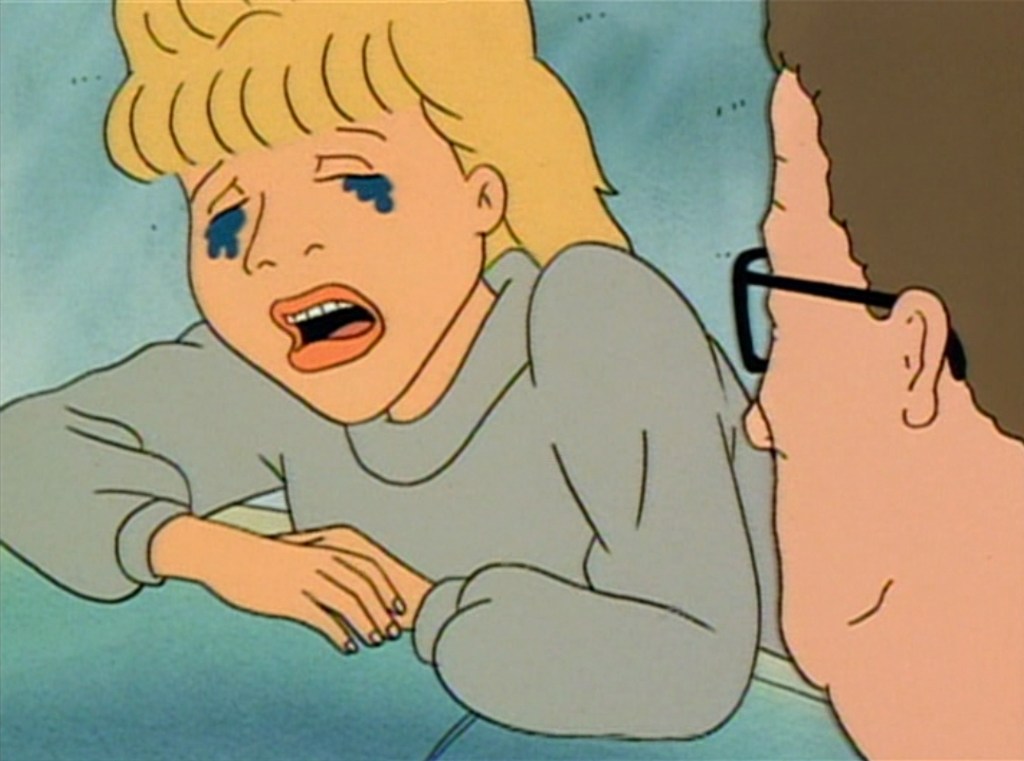
HANK: Luanne, sometimes life throws you a curve ball. Now, there are two ways you can deal with it. You can cry — and that’s the path you’ve chosen — or you can not cry.
LUANNE: How do you not cry?
HANK: Well, instead of letting it out, try holding it in. Every time you have a feeling, just stick it into a little pit inside your stomach and never let it out.
LUANNE (trying it): Are you supposed to have a pain under your rib?
HANK: Yes. That’s natural. The body doesn’t want to swallow its emotions. But now you go ahead and put that pain inside your stomach, too.
LUANNE: I think it’s workin’, Uncle Hank. I feel sick, but not sad.
When a hundred and more years ago my four Grandparents were Children in Hungary, there wasn’t a lot of room for discussion about their feelings, despite major events, including war and famine, all around them. In fact, they prided themselves on overcoming difficult things with hard work and unflappable resilience. They even went as far in congratulating themselves for their perseverance as declaring the next generation downright spoiled and weak. They would have balked at the ideas of therapy and healthy decompression. Today, we know better. Previous generations may have survived unimaginable hardships, but their beliefs about having gotten through unscathed were a delusion. What my Grandparents didn’t digest, whether due to a lack of understanding around one’s emotional household or societal expectation to keep moving on, still found ways to burst forth, and usually sideways. Lunch not on the table at noon sharp for my Grandfather the Judge? He’ll storm out in a big huff and return late into the night. My Father failing to visit my Grandmother for the first of twelve Sundays in a row? She’s sure to have heart palpitations by Tuesday, requiring an ambulance. My Mother decorating the Christmas tree? Her Mother-in-law will be guaranteed to find some dust on some obscure shelf to bring to her Son’s attention. Jockeying for attention in a Family that’s more like a pressure-cooker without a safety valve is par for the course. There is always an undercurrent of slights waiting to be unconsciously avenged and schemes for elevating one’s self by suppressing someone else. In this, very much a scarcity mindset, there must be losers to create winners.
In 2004, I read Eckhart Tolle’s New Earth and learned about the connection between ego and opinions. The ego uses the practice of forming opinions to boost itself (winner) at others’ expense (the losers). I learned focusing on not entertaining one’s own opinions (learning first to not vocalize them, then to not even formulate them) is a spiritual journey in its own right! Eckhart Tolle wasn’t advocating for not addressing of-consequence matters; he simply pointed out bothering to have an opinion about things not ultimately in our purview served only to artificially boost our own self image, or to deprecate it. Both are ultimately unhelpful. In order for me to cultivate what made urgent sense to me, I had to learn to give up one of my ingrained emotion-leaking mechanisms. If I could no longer pontificate on other people’s appearance and behavior, I was giving up an intellectual pursuit (according to my Father’s teachings anyway), and a sideways decompression channel behind which I could hide, like the rest of my relatives. Thankfully, I wasn’t afflicted with the worst opinion aggression of all time: sarcasm. Coming back from sarcasm as a coping mechanism would have been much more difficult.
I pursued leaving behind the practice of opinion-giving with great commitment. I found that any fraction of opinion-generating I incrementally gave up made for tremendous gains for my peace of mind on one hand. On the other hand, I wasn’t realizing I was lagging in directly digesting my emotions. As I was no longer leaking my frustrations through my freewheeling opinions about all kinds of things, I had also dammed up an energy-flow exiting my body. Thankfully, I was also learning about Imago Relationship Therapy, an approach to understanding ourselves and each other through our childhood. Respecting that each of us formulated our sense of what’s love and what Family looks and feels like in our early years, we can see how that drives our perception of all subsequent relationships. There will always be familiarity in the brand of love our original Caregivers provided, and therein lies our ultimate personal challenge and opportunity. If we accept that we are subconsciously attracted to the energies of our childhood Caregivers (be that Parents, Siblings, influential adults), we will recognize our blindspots in choosing Friends, employment environments and Significant Others, including a Spouse. It takes tremendous, dedicated work for us to grow up and away from our early emotional experiences. This point, I cannot overstate. …and it’s impossible without deliberate, emotional digestion.
According to Harvard Business Review, resilience is not about how you endure but rather about how you recover.
https://hbr.org/2016/06/resilience-is-about-how-you-recharge-not-how-you-endure
While the context is one’s professional life, the same is valid for the personal side. Whether experiencing life a thousand, a hundred, ten years or ten minutes ago, the emotions of all human beings accumulate, and what to do with that is as rare a knowledge as January sunshine in Seattle. Thankfully, there are many ways to go about emotional digestion, but it has to be a deliberate and cultivated habit. I am not an expert on all the opportunities for developing healthy emotional rejuvenation; instead, my objective is to raise awareness around why it’s critical for each person to not rush past unpleasant, disappointing, controversial, agitating experiences, and especially not deep hurts and heartbreak in all its forms. I am also not just talking about these emotions in real time, but the ones that occurred as far back as one can remember. It’s a lot like cleaning our home or vehicle. We don’t question the need to maintain our physical environment, but don’t necessarily see our emotions in the same vane as dirty dishes, but we should.
Here are examples of emotional digestion tools a simple internet search yields:
- increasing your emotional vocabulary
- becoming aware of your body
- practicing mindfulness
- journaling
- trying creative outlets
- building skills to identify and regulate difficult emotions
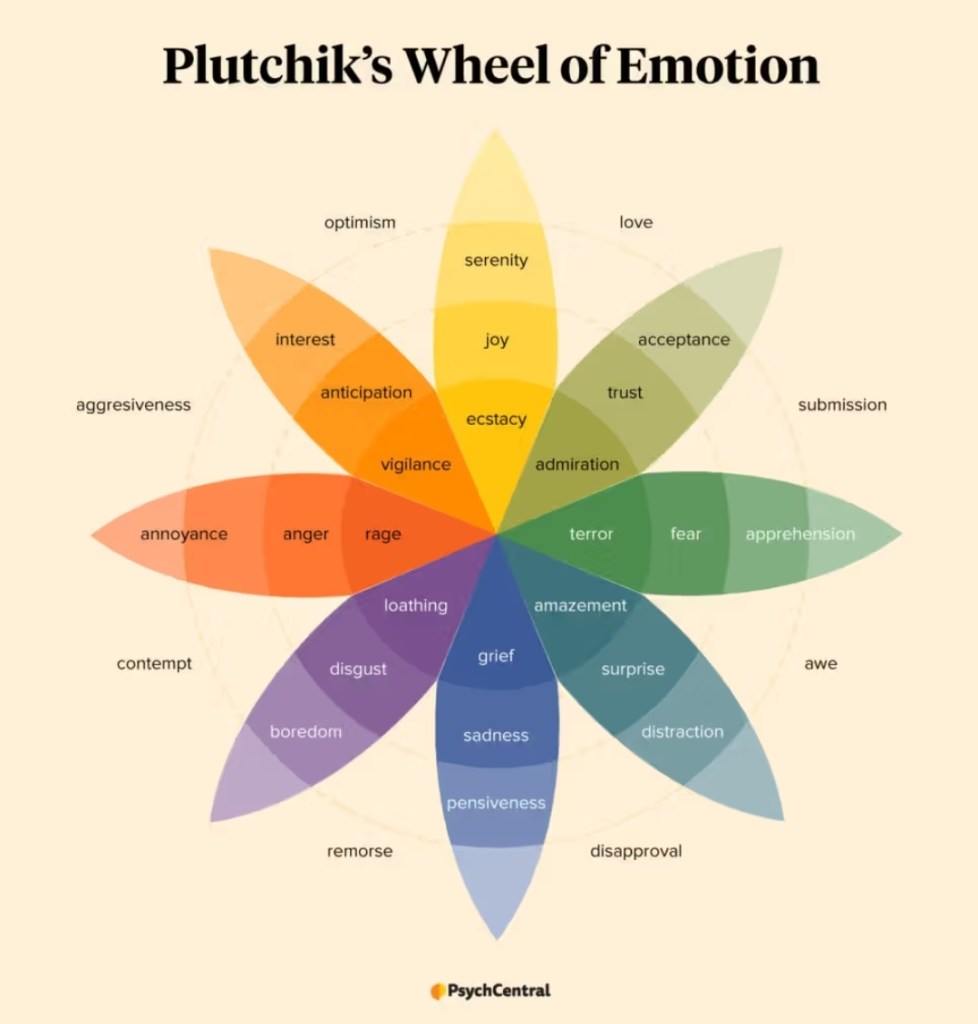
Earlier in this post, I mentioned I was born with big emotions and that emotional Houdinis have always been drawn to me. I’ll take a moment to detail that dynamic. Imagine a person who is expressive, lives out loud, and their impressions and feelings are hardly ever a mystery to anyone around them. They seem to have a broad range of emotions, but they also don’t linger with any particular one for too long, as they are adept at emotional energy flow. This is not to say they have mastered emotional regulation or emotional intelligence, but they generally don’t bottle up their feelings, and certainly not well. Now imagine the person who under-reacts to most things, seems to always be even keeled, but also secludes themselves often, and seldom shares anything they find challenging about their lives. They may live within a very narrow band of moods and emotions because they would otherwise feel such emotional overload, the stimulus would wipe them out. Guess what? These people tend to attract one-another. Either as Friends or Significant Others, they find each other effortlessly, seemintly magically, but ultimately rarely understand the dynamic they are setting up. The dynamic can even apply to Parent/Child combinations; I have seen emotionally expressive Parents overwhelm a Child, and a limited bandwidth Parent repress an out-loud Child. Now, I’m not looking for anyone to agree with me if this is the first time they are introduced to this topic; in all reality, twenty years of life and various forms of therapy have allowed me to see this for what it is: An invitation to upgrade one’s childhood software. I’ll try to explain this, the primary concept behind Imago Therapy.
Emotional opposites are immediately smitten with each other, subconsciously fascinated that the other has such a different approach to showing their feelings. Over time however, they both begin to apply their own emotional rules to the other, creating a fracture for their relationship, along with a lot of angst within both. The live-out-loud will be looking for the short-bandwidth one to be emotionally expressive and transparent, and that person will be perpetually overstimulated by the live-out-loud one, looking for opportunities for a time out. Imago Therapy even has nicknames for the individuals in this dynamic; the Octopus and the Turtle. The Octopus is trying to relate, is reaching out to connect, frightening the turtle who can barely deal with themselves, and absolutely cannot deal with their own feelings and their Partner’s all at the same time. The Octopus then begins to get more and more animated, even anxious, looking to engage the Turtle, but all of this energy overruns the limited-bandwidth Turtle, and they do what turtles do….shrinks further and further inside that handy-dandy shell. The more energetic a conflict (or the more culpable the Turtle feels for it), the faster the Turtle’s capacity for interaction is drained, driving a low-battery mode.
The Octopus has an instinct to ratchet up the noise to be seen and heard as they seek to resolve the topic or conflict at hand, while the Turtle has an instinct to hide alone until the commotion dies down. Neither give the other what the other needs to feel safe and acknowledged. This is how they dig in for a recurring and sustained power-struggle, making themselves and each other miserable, until they are ready to run away, or by some miracle, they find Imago Relationship Therapy. Running away permanently, of course, is easier to do with a Friend or a non-spouse. Often, especially in generations prior, the Octopus-Turtle couples would just settle into zombie marriages. It’s excruciating to figure out and then practice for the Octopus to self-soothe until the Turtle can free up some of their saturation in feelings. It is equally difficult for the Turtle to fight their instinct to retreat until all is quiet and instead to prioritize the Octopus’ needs a little ahead of the Turtle’s need for avoiding conflict. The most fracturing of this Octopus-Turtle dynamic is when the Turtle decides, often subconsciously, to leverage the Octopus for their own emotional outlet. Oh, yes, this is a thing. I know it well. The Turtle will begin to feel the pressure of both the Octopus and their own mounting emotions and stress, seasoned by the heat of the day and the passing of time (so to speak, borrowing a sentiment from Charlotte’s Web). By this time, the goo between the Octopus and the Turtle has begun to smell….like abandoned dirty dishes do. The Octopus eventually gives up in exhaustion on trying to get the Turtle’s attention about the dirty dishes (the goo) and feels very alone. The Octopus’ flame-out means the Turtle finally begins to experience the quiet that feels safe to them. The next hurdle then is to stick their neck out. Surprisingly, the Turtle’s exit-quest is not to deal with anything that transpired thus far, after all, it’s in the distant past now days later, but to get back to normal, unscathed. The Octopus simply cannot fathom moving on without acknowledgment of what they have had to endure, but the Turtle is still not feeling like doling out their limited energy for goo-cleanup. This means the Turtle needs a shortcut. The Turtle, basking in the no-demand of the quiet, begins to attempt the interaction with the Octopus, but to no avail. The Octopus knows those funky dishes are there…the unaddressed relationship goo; no way is the Octopus going to pretend all is well. Having exhausted themselves, the Octopus is now withdrawn, and the Turtle doesn’t like it. The Turtle keeps trying to reconnect with the Octopus and doesn’t understand why the Octopus isn’t cooperating; after all, the Turtle feels better! In increasing frustration at the Octopus’ lingering distance, the Turtle will subconsciously find an obtuse way to get the Octopus to pay attention to the Turtle once again. It will usually be by pushing the Octopus’ buttons, creating a new wave of upheaval from the Octopus. This however, is nothing more than the Turtle getting the Octopus to do the Turtle’s emotional release. The Octopus then feels double exasperated, which is the very expression of angst which serves as the mechanism to deliver the Turtle’s release. The Turtle successfully gets the Octopus to be the Turtle’s release valve.
What can happen next is even more bewildering! Upon inspiring the Octopus’ reaction, the Turtle will often admonish the Octopus for this emotional flare-up by saying: “Your reactions are severely out of proportion with this situation!”, “You are an angry person! or You’re vicious!” all the while, feeling refreshed and now also feeling very much in control, as the one with the anger-free moral high-ground. You see, Turtles subconsciously value creating the appearance they aren’t angry above actual emotional reconciliation.
It’s important to know I’m not describing terrible people here; not even the Turtle, I promise. I’m demonstrating how two emotionally unaware people can continue to churn up unhappiness perpetually.
So what’s the ticket out of this three-ring circus? Both the Octopus and the Turtle must be willing to adopt a little of the other’s emotion-management style. Merely inch closer, not try to become the other, because that doesn’t work either. I took the time to share all of this, because society tends to revere the Turtle and admonish the Octopus. They don’t realize the Octopus’ role in the Turtle’s decompression practice.
Bringing all of this together, I cannot understate the criticality of understanding whether we and our loved ones have Octopus or Turtle tendencies and to lovingly recognize for one’s self the emotional toll of each day. Especially in times of high demand, it’s vital we don’t brush over what stress we are (and, in turn, our body is) experiencing. To be resilient and meet any new day with a clean kitchen, so to speak, we must acknowledge and tend to the daily dirty dishes, well, daily. Some emotional backlog will take years to give honored space and recognition, but with each personal investment in one’s emotional digestion, the cellular level health of the individual will represent tremendous gain!
In my observation, most of us prefer to rush past the unpleasant feelings, ours and others’, but getting in the habit of sitting with them, honoring them (which is not the same as wallowing in them), is the only path to processing them through. The reward? No accumulated dirty dishes, no complicated conversations days later where the parties involved are trying to detangle decomposing goo. No cellular storage of stress, which many believe are the building blocks to various cancers. I am also not qualified to speak with authority on the repressed feelings-cancer connection, but I find others’ work on this topic compelling.
The mind-body connection is very powerful. When my Daughter, at age 18 and a half, set off the chain of events she felt she needed to to feel freedom from her childhood and the person who represented the most constraints in her life, her Mother, I underwent an immediate shock as if she had died. I was so shaken to my very core and devastated, I overwhelmed and depleted my hormonal functions with my adrenaline overdrive. Quite literally every minute I feared for how my Daughter was experiencing this change she put in motion, whether she was safe, and I worried her narrative would fossilize into a hard stance against her Siblings, Anya (Mom in Hungarian; the name my Wife goes by) and me, leaving her without a lifetime-committed support system that wasn’t merely an echo chamber. I replayed a million events, conversations, and decisions; I put myself through my harshest scrutiny to brutally disect and own what led up to this. I had ample time. This was COVID-19 lockdown, and my agony and I had nowhere to go. This is not a woe-is-me account; this is the most deeply important and personal example of the mind-body connection I can offer. In the three months following my Daughter moving out of our Family home, I put my (then) 45-year old body into menopause. Since then, I’ve learned why. I was so heartbroken, I believe a huge, meaningful part of me died. My tremendous and sustained stress-response depleted what my body could support, therefore it had to begin sacrificing my reproductive hormones to keep me afloat. Over the following two years, my grieving the loss of my Daughter from our lives completely changed my body. I could see my devastation, my adrenaline rection manifest itself in and on my body. It has been four and a half years of this:
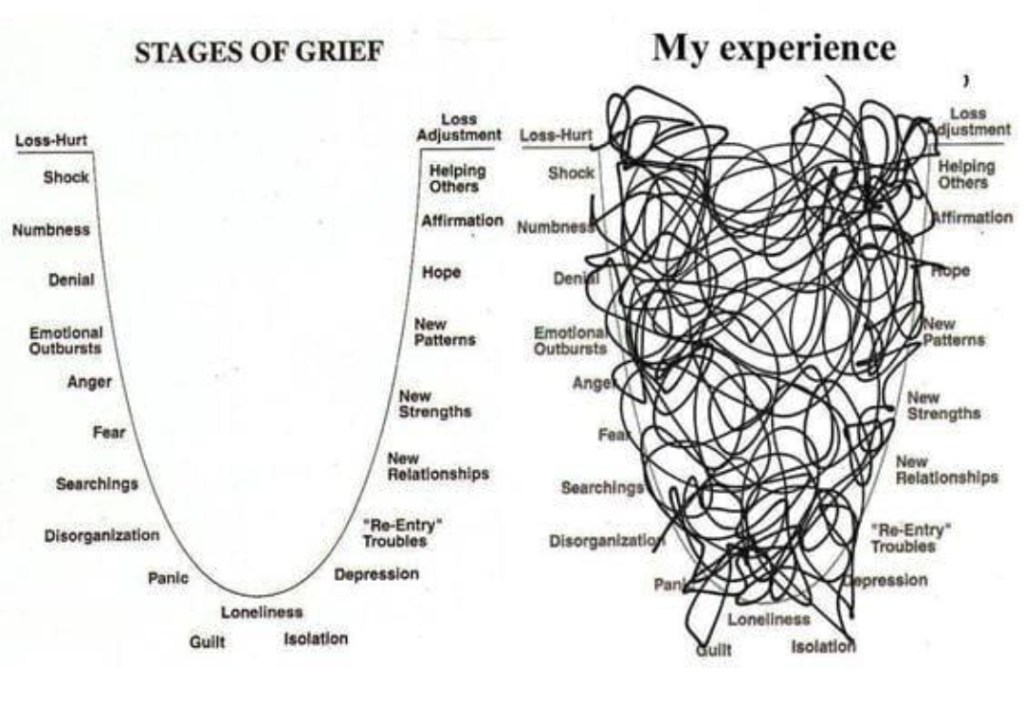
I am working with my new normal now. It looks something like the bottom row of jars:
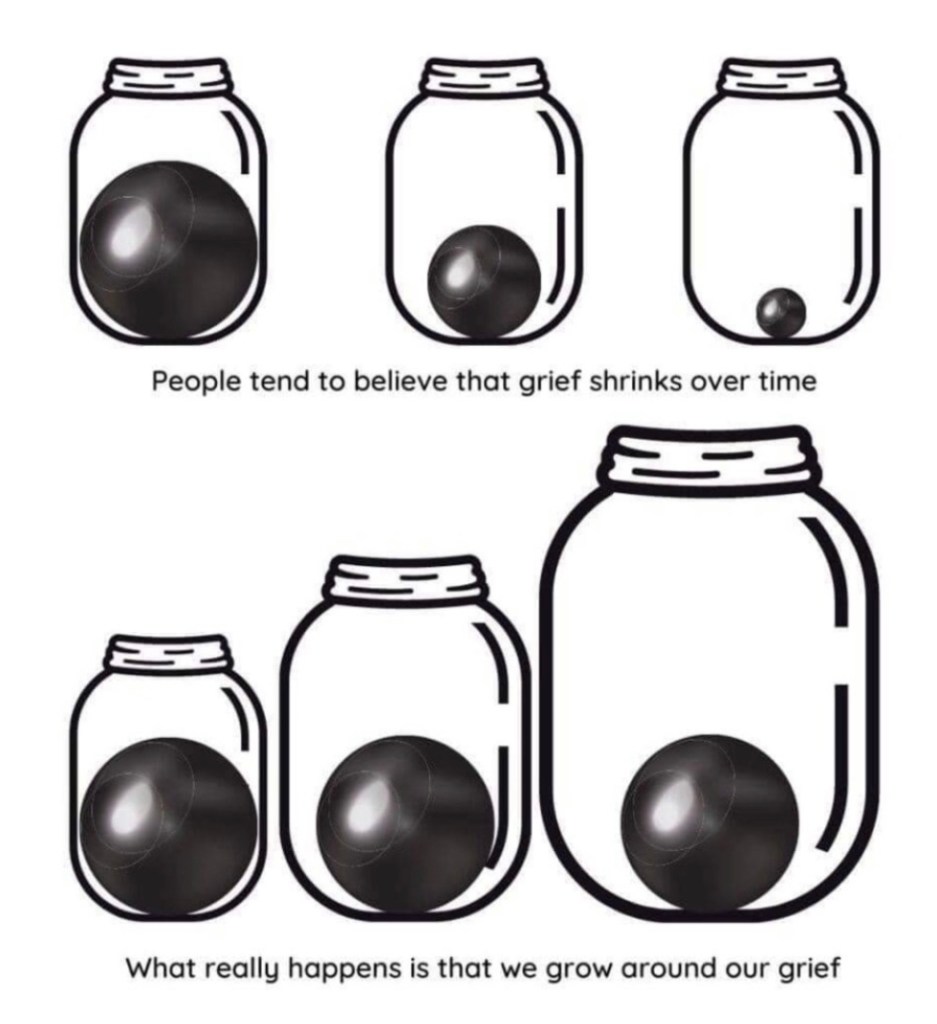
I am grateful for the resources others wrote in books and have brought onto the internet so I and others can find a life vest while drowning. Life is messy. We cannot avoid conflict, we cannot avoid dirty dishes. …but we can practice daily recognition of our rainbow of feelings and allow them to move through like dignitaries in a workplace, ensuring they don’t get stuck.
“The thing is, our body is actually calmed by the expression of grief, if we allow it. And the calm that follows is like a return to the flow of life and has the quality of magic, but it is also a real physiological phenomenon. Some people turn grief away at the door, while others invite it in to make itself at home in our lives. Our ability to work with grief mindfully means to simultaneously meet the powerful force of grief when it arrives, and let it move through us, unimpeded by the thoughts that would turn it into a story about our sadness. Behind each wave of grief that I met with mindfulness was this vast space that opened up around my experience; and beyond the grief was this sense of joy and gratitude for this precious life.” ~Karine Bell


Leave a Reply