Professionally, I have benefitted greatly from the Mentors who generously gave of their time, their experience, and in many cases I’m confident, they gave of their patience in my mentoring meetings with them. Through these Mentors, I have learned insights into organizational dynamics, the nature of leadership, the value of relationships, people’s capacity for organizational change… all invaluable perspectives I on my own would otherwise not decipher. I needed every bit of their good will in teaching me, as I didn’t always show up with a brain turned to ‘sponge’ mode. I frequently presented with the emotions and tactical problems of my circumstances, vs ready to absorb wisdom to transcend the ‘eaches’ of my everyday challenges and to formulate and nurture a long-term career strategy.
I have had formal and informal Mentors, short-term and those I’ve known for years. With some, I wondered if they stayed in the safety of HR guidelines, afraid to give me constructive feedback in a direct manner, or because they weren’t confident how I would receive it. Both valid decision-parameters, I have come to appreciate.
A few nights ago, I reconnected with a Mentor who has retired since the days we interacted frequently. Therefore, I wasn’t even sure it was fair for me to bring up much about my work world, as too many important things occurred on their side I was hoping to catch up on. It is also very helpful to me to see how professionals – executives, especially – navigate their early retirement years. Over dinner, I was grateful to be entrusted with their health update, and I thought, “Definitely, I can graduate from me burdening them with my here-I-am-in-this-boat-again story about my work environment and keep our conversation focused on hopeful, forward-looking subjects.” I was, first and foremost, committed to us having a nice time catching up.
Eventually, though, our conversation did shift to my current work. I am in a new-to-me organization where I am temporarily contributing while the federal government completes another loop around a Presidency. Political appointees of one Administration begin to depart for their next lives ahead of the election season, leaving holes and functions the career Civil Servants must cover. It then takes time for a new Administration to appoint their people to government leadership posts, allowing the career Civil Servants to return to their regular spots. From this temporary capacity, I was sharing my organizational observations with my Mentor, who has heard me do so in years and circumstances past. Multiple of them. I was aware I was my own Groundhog Day, and I also suspected I had a role I was not grasping. It’s like when the guy in the joke goes to the doctor to demonstrate how his knees, his back and head hurt when he touches them, only to be diagnosed with a broken finger. Listening patiently to my same-shit-different-day accounting of my work world, my Mentor casually said: “You don’t suffer fools!” They said it so nonchalantly, I could have missed it, and that would have been a crying shame. As such, their words struck me the same immediately compelling way the Eagles lyric “Every Form of Refuge has its Price!” had pierced my consciousness, so many lifetimes ago.
The next day, my Mentor’s words still acutely circling my brain, I turned to my new toy, Gemini, and consulted its Artificial Intelligence capabilities to explore the nature or characteristics of those who don’t suffer fools. I had a hunch I needed a comprehensive look at what the phrase means and all the layers it could imply. The good and bad, so to speak. The light and shadow sides. Gemini did not disappoint.
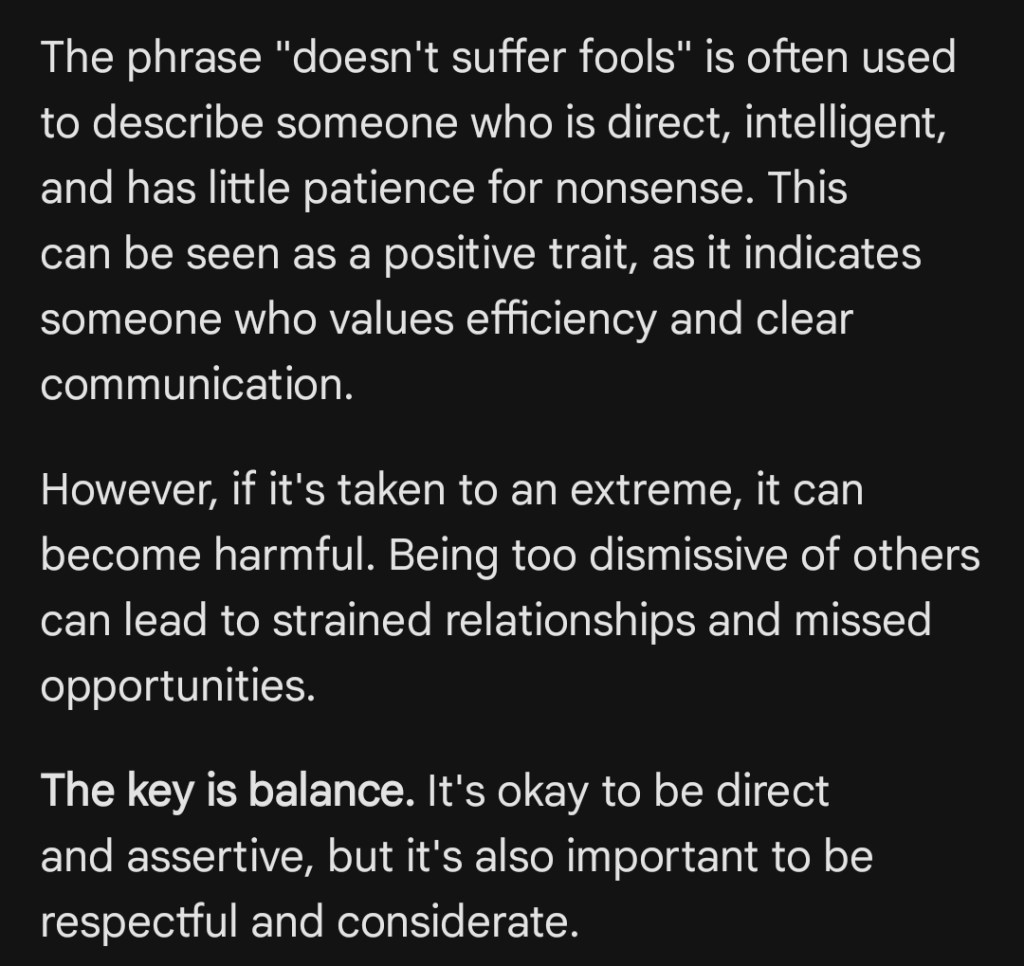
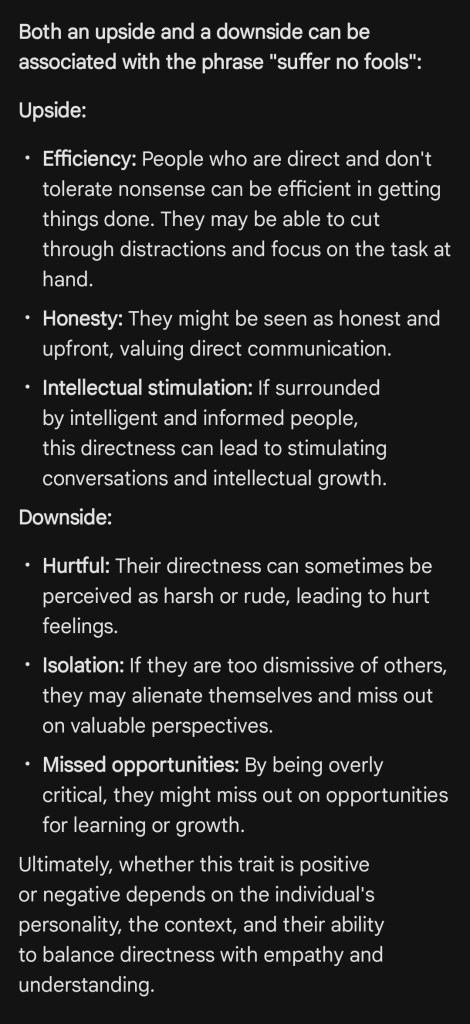
Brilliant! Simple, slicing right to the center of the matter, the center of my professional challenges, and the single-most critical personal growth area for me. I was both flabbergasted by my Mentor’s keen assessment and titanium phrasing, and relieved by the clarity of the practice I must wholeheartedly adopt to be a better human and leader. I felt seen, despite the unpleasant part of having to accept the downsides of this characteristic. Running from it would not render it untrue, while embracing it could lead to a new chapter in my life.
I have always been that Friend who cuts through to the bottom line of situations, and without sugarcoating, decodes the predicaments my Friends approach with what I see as their wishful thinking. My Friends come to me when they are in need of difficult reflections… when they want to get to the core of an issue because they are ready to act. I have long known I am not the one they seek out when a situation is new and tender, as I tend not to react with their potentially fragile state in mind. Instead, I am convinced the best way to support them is to help them rapidly sort out what a third-party (in this case I) can readily see. Not wasting their time and tears is my first priority, whereas I fall short on the also vital empathy. Not good. It’s not that I don’t care; in fact, I care deeply! …which is why I want to deliver the fastest way for them to stop doing their part in a situation and establish the boundaries they deserve. In that process however, I de-emphasize their hurt feelings.
It’s also how I treat myself and how I react to circumstances in my own life: with a lot of swift logic, mowing through my emotions. Reflexively, I want to act, to move myself and others out of the pain zone. It’s a little bit like Joy in the movie Inside Out; she had to learn the critical role of Sadness and honor Sadness in her [Joy’s] own growth journey. …except I’m not Joy. I’m the middle-school PE teacher: “Move, move, let’s go, People!”

I’m not good at meeting people and situations where they are. I don’t reflexively lead with empathy. My eye is fixed on the future state, and I enjoy the dopamine boost I get from that. At different times in my life, that future vision was the difference between debilitating depression and functional survival. It has served me well in those times. …but employing survival skills in one’s daily life is counterproductive; this is my clear opportunity to grow, to cultivate new reactions and new tools.
In my professional life, I have tended to assess organizational dynamics quickly and learn who within the executive cadre had what authority and orientation for making change. Where I saw bias toward the status quo coming from the top despite their grasp of an imperative for change, my reflex was to run. Who am I kidding with the past tense? My reflex today is to run. This is (also) where my Mentor’s words fit in. If I can apply empathetic interpersonal skills and weave that in, I can become a more impactful advocate. I’m reminded of the quote (its origins are in question): “If you want to go fast, go alone; if you want to go far, go together.” Going together means meeting people where and as they are. That takes investment in their perspective in a more interested and involved manner than simply accosting them with an imperative for the future. Ouch, but an invaluable lesson for me both at home and at work.
Thank You, My Retired Mentor! See you soon for dinner and the theater!

 One More Perspective
Leave a comment