Upon my first hearing of this Taylor Swift song, I immediately bonded with several of the lines. They sum up how my Mother has always related to me, pointing her finger away from herself and reflexively, at me. Over the decades, it became My Mother’s unchallengeable routine, branding me with the judgment for a variety of issues she herself had no wherewithal to process. It is precisely how my Mother, over the last ten years, drew my Children close to her, discrediting me by sharing with them one-sided, single-perspective, context-free information about my childhood autonomy, teenage years of exploration and adult years of exasperation. …and I had no idea this is how Nagyi (Grandmother in Hungarian) had been spending her very little time alone with my Children, her then preteen and teen Grandchildren. My Mother, without my permission, chose to open the door on elements of my life, so as to give my teenage children the impression I was a hypocrite holding them to standards and values I didn’t follow at their age. “You don’t have to do what your Mother says; she didn’t do that when she was your age!” was her message and my teenage Children thought she was the coolest Grandmother on Earth. My Mother glowed with validation, I was misreading as fulfillment from having us part of her life again. In her mind however, she had preemptively inoculated her Grandchildren against anything I may have shared with them about her and my childhood. By dishing the dirt on me to her bright-eyed teenage Grandchildren, my Mother ensured I could no longer judge her; in a sense, we were even. She saw to it my Children had the ammunition to first and foremost judge me instead.
Conveniently however, my overnight popular Mother failed to mention her role in my childhood, most importantly, her persistent absence during very critical years of my growing up. Most devastatingly, my Mother robbed my Children of a sense of structure she did not have, she did not give to me, but what I worked hard to provide to my Children, and of the security that comes from having rules which also communicate “I love You, I care about your safety, your future, your conduct, your perspectives, and whether you have on sunscreen!”
This is the source of my most acute pain and motivation for this writing; being given a childhood environment in which I had no control and no support, then punish me for the rest of my life for how I coped in it. No hearings, no expert evaluations, no defense attorneys. Of course, I understand those who created my childhood environment endured the same themselves and are still operating based on the original survival skills they learned during their upbringing. Honoring their stories is why I dedicated the earlier chapters to them. I want to give context to my Family’s amalgam of lived experiences so as to uplift their human complexity.
For what’s nearing two decades of slow but diligent study and years of Imago Therapy, I have been working to understand the bigger human dynamics at play within my Family and society at large. It is most critical now, as I keep growing along with my (now twentysomething year old) Children and I transcend my child-rearing years. Like Children must find their own identity and value system away from their Parents’, most Mothers must make the journey to remember that their own agency and value as humans are still much larger than their parenting role. The parenting years are so desperately important, and when Children grow up, many Mothers are left to reconcile a shell of themselves against a report card given to them by those who least understand what it took to arrive to this point. For some Mothers, there are advocates who stand up and show compassion for their journey and step in to offer a counterpoint to any harsh, context-free judgements against them. Grandparents, their Spouse, Siblings or even a Best Friend may introduce a perspective of love and natural constraints of what it’s like to raise three Children; unfortunately, my Children and I benefitted from none of that.
This website, my collection of writings, is a result of my decision in 2023 that my suitcase of life was too heavy. I was no longer going to carry everything forward with me. I needed to break my invisible, but powerful baggage open and unpack it. It was most critical now for me to examine the contents of my life suitcase for processing through to rest, or with deliberate determination, to repack it for the forward journey. Deep energies surface when doing this work, and following an intense period of my writing last fall, my gallbladder raised its hand in agony, wishing also to be among those left behind. It was very symbolic and for my Wife, utterly scary.
In writing this account, I will continue to rely on the building blocks of the previous chapters I have written and my foundational principle that I am not writing about good and bad people, but rather about facets of a select number of the complicated humans we all are. In the end, I wish for my writings to serve as a way to process many generations’ worth of life-altering, often crushing, events my Family members endured, and with that, to bring my Family into a compassionate space. To many, it will seem to make little sense to let wounds bleed, but covering them up is the very thing that has caused a lot of destructive pressure in our lives to come out sideways. …and I learned long ago pressure always finds exits. It’s the very people who pretend not to be angry, to have no conflict in their lives, who claim to have forgiven and moved on, who will be the most cloaked and covert about how they really feel. Ultimately, these seemingly unflappable individuals will also be the most damaging. It took almost fifty years, but finally, I have learned to guard myself from the self-professed, peaceful people who genuinely believe to have transcended the negative emotions in their world. Most people don’t tend to realize, without dedicated therapy, they are perpetually acting out a programming from very early in their lives, when they garnered the most attention from their Parents, Siblings and Caregivers upon behaving happy and agreeable. Therefore, they were taught to suppress their less-desirable emotions, and they began to label anger and fear and all other challenging emotions, as bad. What’s bad, then the logic goes, should be avoided and condemned. I, on the other hand, somehow made it out of my childhood with my willingness to express my negative emotions. This was very unlady-like, to say the least, and I received ample disapproval along the way. As far as my Mother is concerned and has been quoted, I am dehumanized to a single descriptor: a Nazi.
Though I have woven a good amount of my own life into the previous chapters about my Family members, here, I will expand upon the story of me, while also striving to represent my beliefs around how different people experience each other differently. I will continue to honor the (what I call the) ninety-nine facets of every person and be very forthright about my own experience with them, which is not to say that what I describe is all there is to them as people. My life story intersecting with theirs does not define them. It also does not define me. With what I do write however, I acknowledge for myself what I experienced, I validate my own feelings, and in that process, I more healthily release those feelings.
My earliest memory is a snippet of our very first flat. I must have been eighteen months old. I was in a bed and I understood not to move nor make sound. It was dark in the room I was, but the door was ajar, and the space into which the room opened had light. It also had significant angst, an intensity I would learn to know as my Family’s baseline…an ambient uneasy emotion in my household, and I felt safest keeping quiet. My next memories are of the era I recall with my Parents together, my Brother, born nine years before me to my Father’s first Wife, living with us. By now, we were living in a brand new downtown highrise that was 595 square-feet of privilege in Communist Hungary. It was made from prefabricated concrete panels, towering to ten stories high. I would live here through age fourteen.
I had to learn to navigate the adults’ moods and alliances in my immediate and extended Family very early. To master those, I also had to start clamping myself down to make sure I didn’t add to the perpetual emotional upheaval. I was not to show too much enthusiasm to my Mother nor Father about the people and subjects they didn’t like, so I learned to instinctively compartmentalize my behavior and words, and to accomplish this meticulously. It also meant I had to meter my feelings so they didn’t detract from my ability to adjust to my environment on the fly. One may say: “How could a young Child do all that by age three and four?” I say: reflexively. Imago Therapy is built on this observed phenomenon. I think Children do this in all societies, around the globe, just to varying degrees. …but what happens to the difference between what a Family environment requires of a Child versus the traits and temperaments inherently within that Child? That gap represents the conflict between the self and the Family or society. For some, the gap is small; for others, like an introverted child in a Family of extraverts or a gay teen in an evangelical Christian Family, the gap may as well be the Grand Canyon. Along the years, I have routinely underestimated the impact this gap and how one endures it. More on this, later.
At age three, my household consisted of my Mother and Father, my Brother, age twelve, and like most European urban living, my Parents had the room that doubled as a living-room by day amd their bedroom by night. My Brother had the second room in the flat, and we had a kitchen, a water closet (toilet) and a bathroom with a bathtub, a washer and a separate centrifuge machine, each with hoses that drained into the tub. There was a drying rack suspended from the bathroom ceiling on a pulley, so it could go up and down.
I remember feeling full of possibilities and energy in those early single-digit years; I loved living in a busy city with so many ways to go from here to there, and every day, there was somewhere to go. Our highrise neighborhood was right behind the main street of a steeltown in Northeast Hungary, which snaked through and defined the various segments of downtown and the rest of the city. We walked to the neighborhood grocery store, and near it were the preschool, Pediatrician, flower shop, ice cream shack, confectionery, and beauty salons of all varieties. A few more minutes of walking would get us to the main street downtown which contained the movie theater, the performing arts hall, the large, state-run stores with clothes and appliances, and many, many county government offices. The electric tram bisected the main street, and in my early childhood years, busses and cars still ran up and down alongside the trams. In the early 1980s, the city decided to close the main street off to all but pedestrians and the trams, and it was a beautiful transformation. I loved walking up and down that street as if it was the Champs-Élysées, the Magnificent Mile, or Madison Avenue. No matter what was going on at home, and it was always a lot, I could escape to walk on the main street and sense a bigger picture, a world larger than my own.
I have as many memories of moving about the city by myself before turning six years old as I do accompanied by someone. For one, in those days, everyone grocery-shopped every day for their necessities, save Sundays. Bread, milk, meats and cheeses were not processed nor preserved, so keeping them for two days was not feasible, and besides, a 500 square-foot flat had a refrigerator not much bigger than a dorm fridge and other storage was likewise limited, so buying in bulk was unheard of. Brown paper grocery bags were a little-understood novelty in American movies. We carried a basket or a woven canvas bag to the store and piled the bleach in with the bread wrapped in a single crinkly paper sheet. Nothing was big; eggs were sold by the eaches. Before I turned six, I hadn’t tasted snacks in colorful, puffy packages, I had virtually no soda and I ate bread with every single meal, breakfast through dinner. This wasn’t because we were poor. This was cultural. Actually, for the most part, I actually grew up eating quite well. My point is, I began doing daily grocery shopping before I could read. It was good.
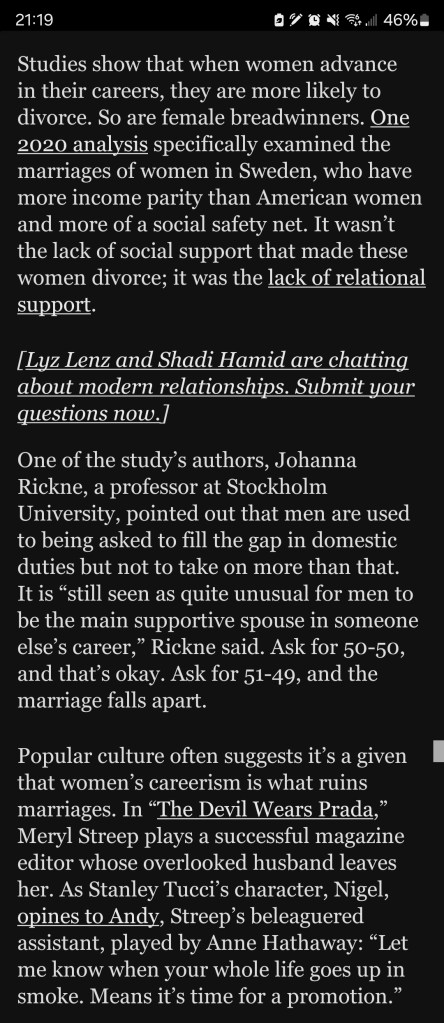
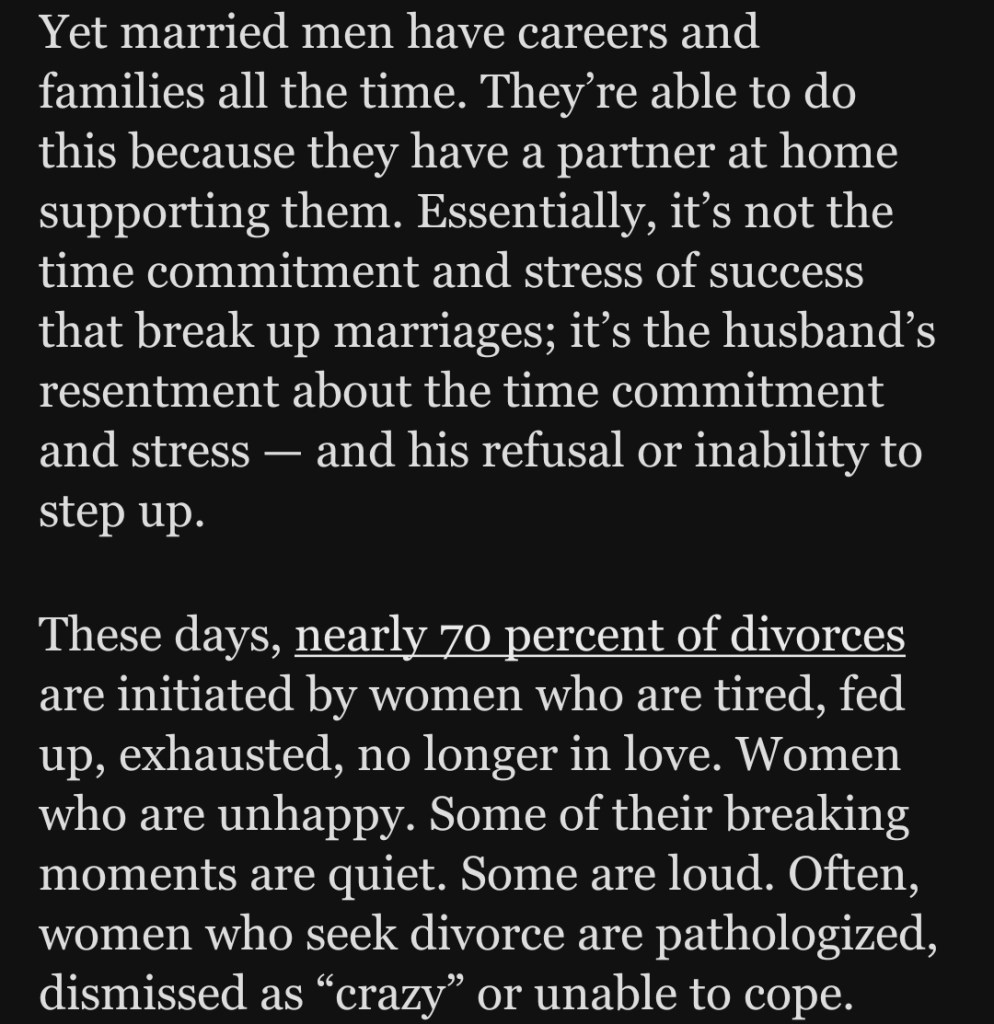
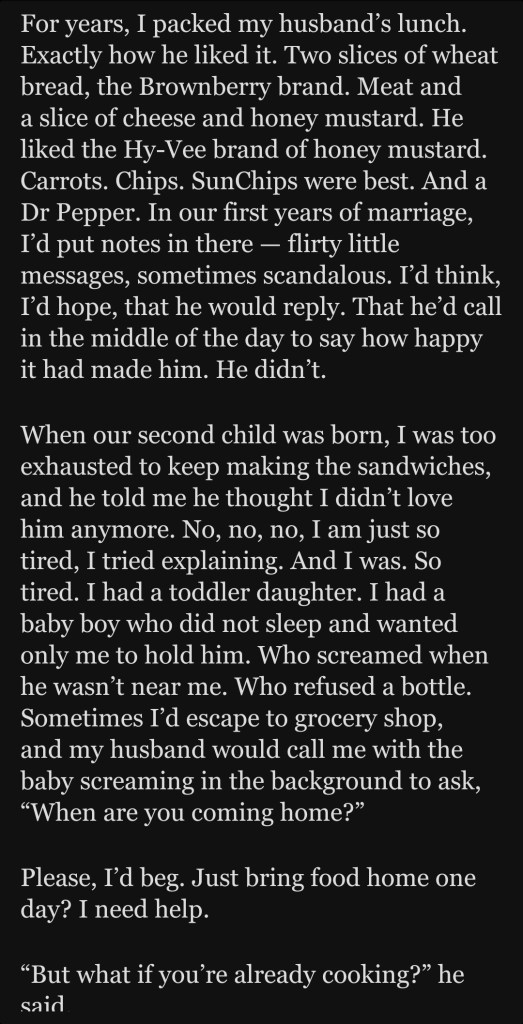
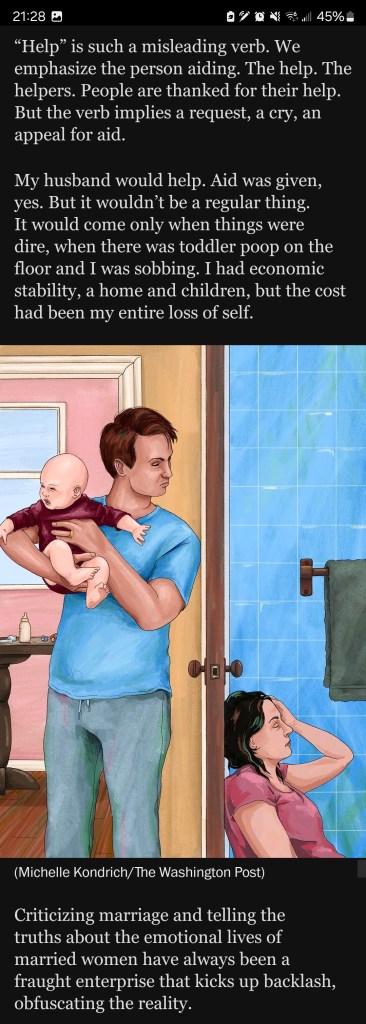
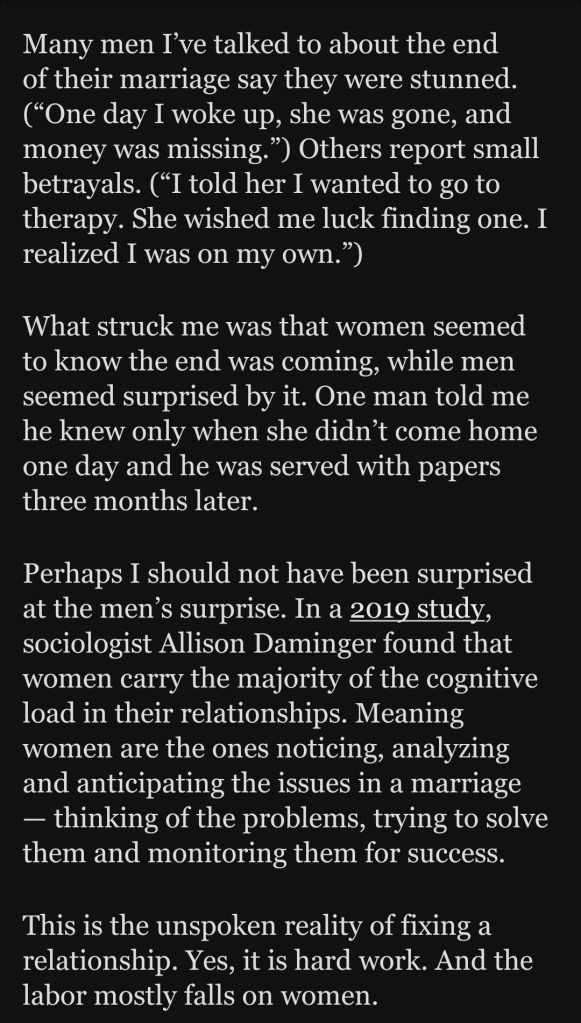
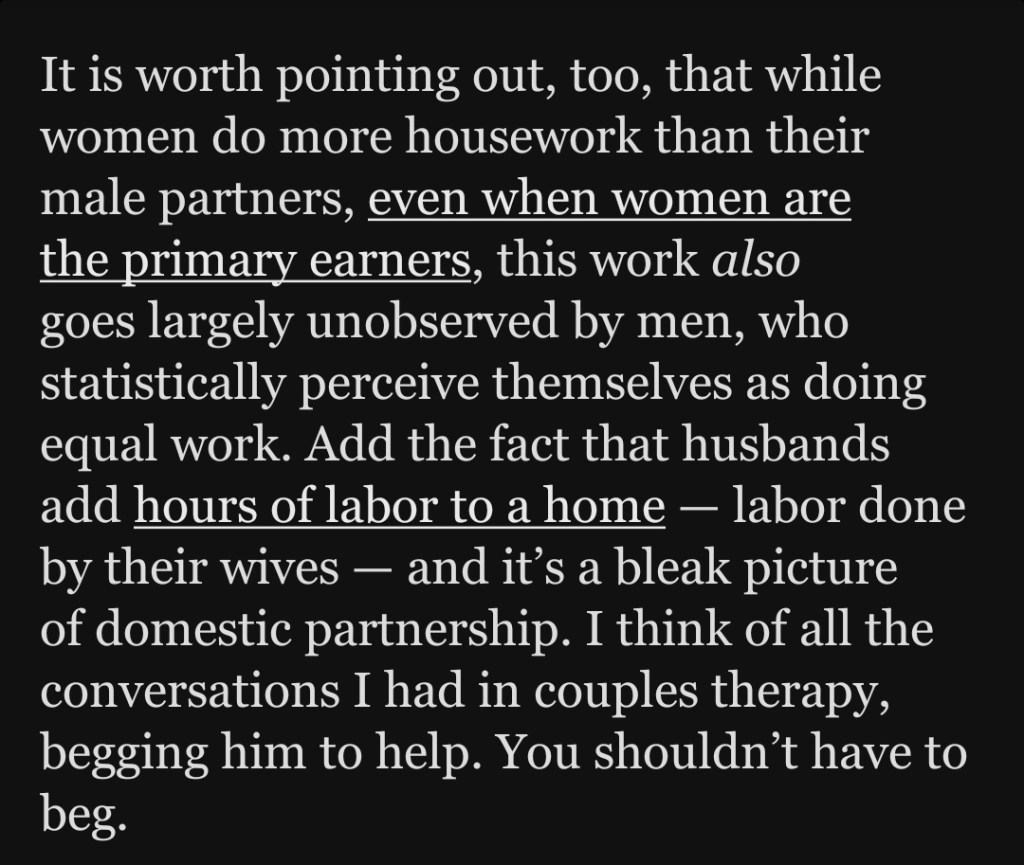
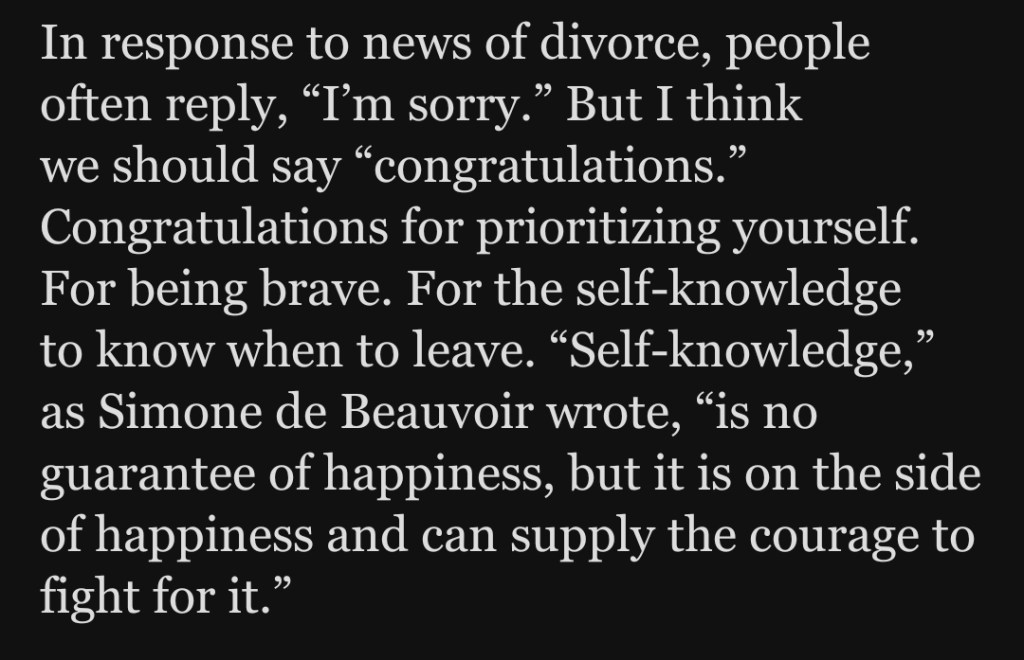
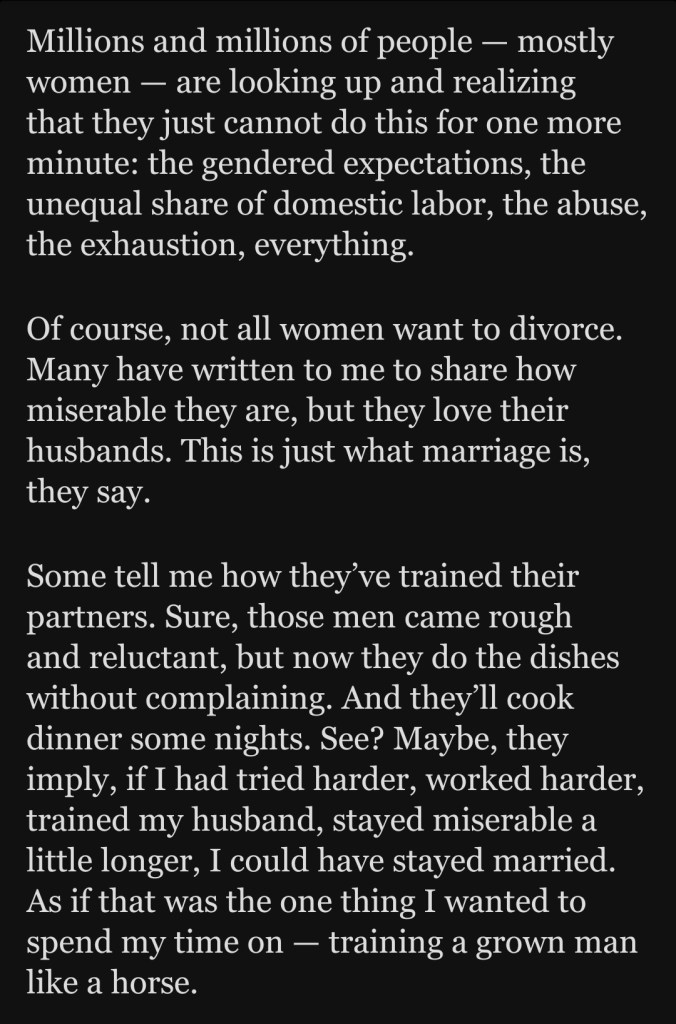
I will eventually finish writing this chapter in my voice, but in the meantime, this article is an effective stand-in:



 One More Perspective
Leave a comment